A traveler eats alone at a small diner in a city she will never visit again. No return trip planned, no friends in common with anyone at the table, no chance the waiter will ever learn her name or she his. She leaves a generous tip anyway, well above what local custom would even notice, let alone reward.
Nothing in the six models covered in the first article of this series can explain that. Every one of them, without exception, described a single mind making a decision that ultimately only affected that mind, what it expected, what it regretted, what tempted it, which number caught its attention. None of them needed another person to be real. This moment does. The waiter's welfare enters her decision directly, not as a means to some payoff back to her, there isn't one coming, but as something she appears to value for its own sake.
Classical game theory has an answer for repeated generosity: reputation, future favors, the shadow of games still to come. It has nothing for this. One shot, no audience, no future. And yet this exact pattern, cooperation with no possibility of a future payoff, shows up so reliably in laboratory experiments that it needed its own name and its own formal apparatus, five separate models, each closing a different gap in what happens once another person's welfare enters the equation.
Chapter 1Where Self-Interest Alone Stops Explaining Behavior
Before building each model, it's worth being precise about what's already covered elsewhere and what genuinely isn't. Artha's earlier behavioral economics material, and the first article in this series, already established that people care about fairness in outcomes: Güth's original ultimatum game showed responders rejecting unequal splits even at a direct cost to themselves, and Fehr and Schmidt's 1999 formula, , captured this by making a player's utility fall whenever the split between them and someone else becomes too unequal, in either direction.
That formula cares about outcomes only. It has no way to represent why the split ended up unequal, an unfair split from someone who tried their best and simply couldn't do better registers identically to one from someone who deliberately shortchanged you. Five gaps follow directly from that limitation and others like it.
| Gap in Outcome-Based Fairness Models | Which Model Closes It |
|---|---|
| Cares only about how equal the outcome is, not whether the other person was trying to be kind or cruel in producing it | Rabin's Fairness Equilibrium |
| Has no account of giving that expects nothing back at all, not even a future favor or a fairer split next round | Warm-Glow Altruism |
| Assumes players already know the game's payoffs and each other's intentions; says nothing about trusting someone before any of that is known | The Trust Game |
| Treats every player as a payoff-maximizer with no self-concept; has no room for someone who'll accept a worse material outcome to protect who they believe they are | Identity Economics |
| Assumes every other player reasons perfectly, with zero noise; has no account of a genuinely fallible, imprecise opponent | Quantal Response Equilibrium |
What Is Rabin's Fairness Equilibrium?
The mechanism. Matthew Rabin's 1993 paper, "Incorporating Fairness into Game Theory and Economics," starts from a plain observation: "people like to help those who are helping them, and to hurt those who are hurting them." That's a claim about intentions, not outcomes. Fehr-Schmidt's formula would treat a stingy offer from someone with no better option and a stingy offer from someone deliberately being cruel identically, both just produce an unequal split. Rabin's model doesn't. It asks whether the other player is choosing to be kind or unkind, given what they could have done instead, and rewards or punishes accordingly.
The formal model. Each player's utility depends on three things: their own material payoff, how kind they are being to the other player, and how kind they believe the other player is being to them.
| Term | Meaning |
|---|---|
| Player 's overall utility, the actual quantity being maximized, combining raw material payoff with the emotional charge of perceived kindness or unkindness | |
| Ordinary material payoff, exactly what a purely self-interested player would care about | |
| How kind player is choosing to be toward player , positive for generous choices, negative for spiteful ones | |
| Player 's belief about how kind player is being toward them, again positive or negative |
The multiplication is the entire insight. When both terms share the same sign, both positive (mutual kindness) or both negative (mutual spite), the product is positive and utility rises. When they have opposite signs, being kind to someone perceived as unkind, or unkind to someone perceived as kind, the product is negative and utility falls.
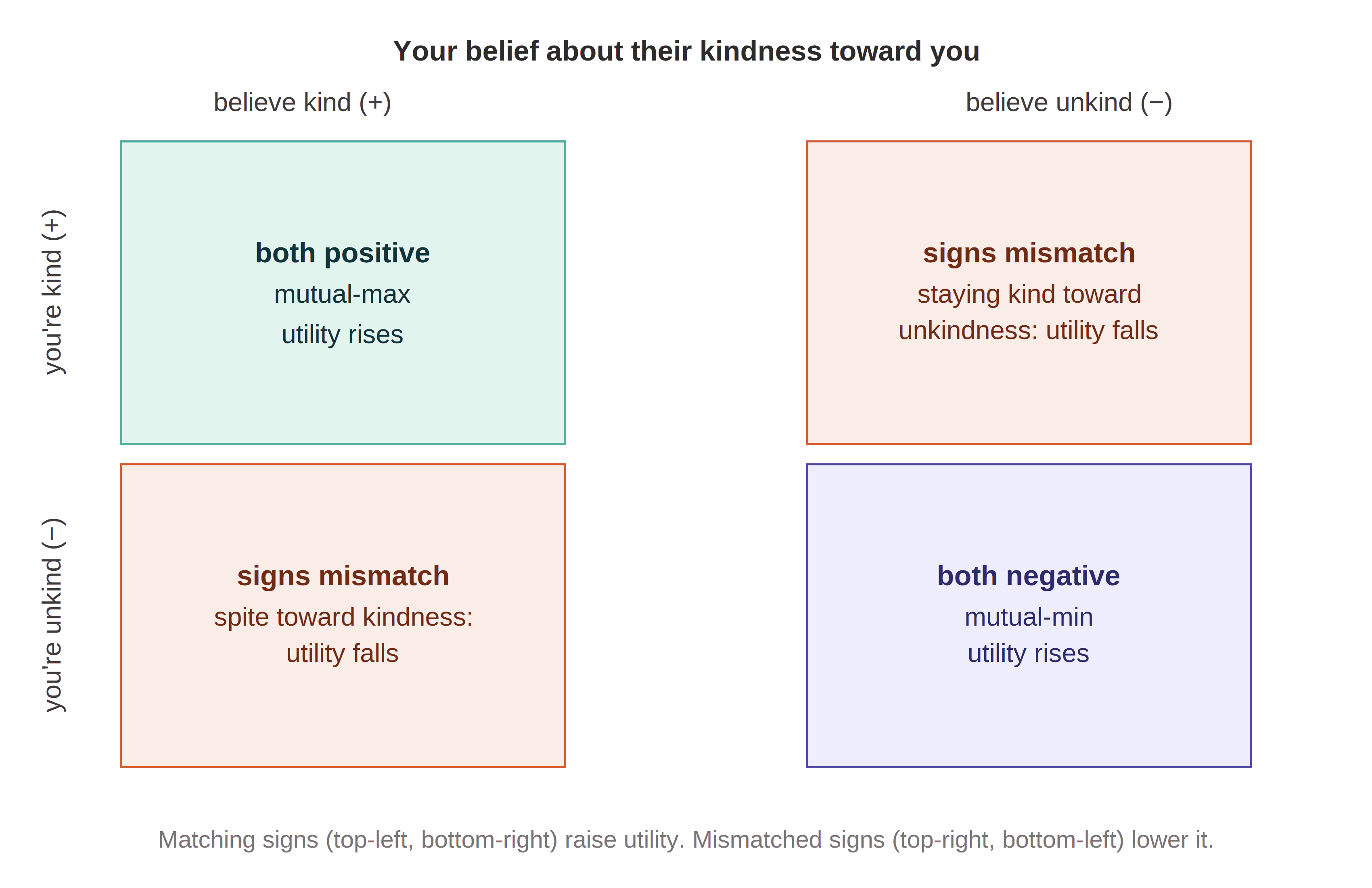
Rabin calls the two stable outcomes this produces mutual-max (both players maximizing each other's payoff) and mutual-min (both players minimizing each other's payoff), the fairness-equilibrium analogues of cooperation and mutual spite.
Worked example. Take a baseline material payoff of and compare three scenarios, holding the player's own kindness choice fixed at (a mildly spiteful response) against three different beliefs about the other player:
| Scenario | Calculation | ||
|---|---|---|---|
| Believes other player is being kind, responds with spite anyway | |||
| Believes other player is being unkind, responds with spite | |||
| Stays kind () toward a player believed unkind |
Reciprocal spite toward a perceived-unkind partner (9.75) beats staying generous toward that same perceived-unkind partner (9.25). That's the model's real content: it doesn't just predict people avoid unfair outcomes, it predicts they'll actively sacrifice material payoff to retaliate against unfairness they believe was intentional, and that this retaliation is itself utility-maximizing once intentions enter the calculation.
Rabin's original model was built for simultaneous-move games, choices made without seeing what the other person does first. Martin Dufwenberg and Georg Kirchsteiger's 2004 extension, sequential reciprocity, adapts the same logic to the more common real-world case: a negotiation, a favor, an insult, that unfolds in stages, where each move can update what the other person believes about your intentions before they even respond.
Where this shows up in practice. Ernst Fehr, Georg Kirchsteiger, and Arno Riedl's 1993 experiment built a labor market with deliberately excessive supply of workers, guaranteeing a wage low enough that a purely self-interested employer had no reason to pay more, and a purely self-interested employee, once hired, had no reason to work harder than the bare minimum. Real behavior broke that logic on both sides at once: employers who voluntarily offered wages roughly 140 percent above the market-clearing rate received effort roughly 300 percent above the required minimum in return.
That finding is the experimental backbone of what labor economists call efficiency wages, paying above the market rate not out of charity, but because a wage read as a deliberate, generous choice tends to get reciprocated with effort a purely incentive-based model, one that only cares about detection risk and punishment, would never predict on its own.
Chapter 3What Is Warm-Glow Altruism?
The mechanism. Standard economic theory carries an old, uncomfortable prediction about charitable giving, sometimes called the crowding-out puzzle. If a public good, clean air, a vaccine program, a disaster relief fund, benefits everyone regardless of who paid for it, a purely self-interested person should contribute nothing and let others cover the cost, and even a purely altruistic person, someone who genuinely only cares about the total good getting done, should reduce their own giving rupee-for-rupee whenever someone else's contribution, or a government program, already covers the same ground.
Real giving doesn't collapse this way nearly as much as pure altruism predicts, even when government spending on the identical cause rises substantially. James Andreoni's 1990 paper explains why: people don't only care about the total good getting done. They get a separate, private payoff from the act of giving itself, a "warm glow" that exists whether or not their specific rupee moved the needle on the outcome at all.
The formal model.
| Term | Meaning |
|---|---|
| Player 's overall utility, the actual quantity being maximized, combining ordinary outcome-based satisfaction with the separate warm-glow payoff from giving | |
| The person's ordinary, outcome-based satisfaction from their own consumption and the total public good, exactly what a purely altruistic model would already include on its own | |
| The person's own private consumption | |
| The total level of the public good provided, including everyone else's contributions | |
| This specific person's own individual contribution | |
| The warm-glow term: utility drawn purely from the act of giving , independent of how much the total actually changed |
The presence of , defined over the person's own contribution alone, is what breaks both the free-rider logic and the crowding-out prediction. Under pure altruism, only would matter, and one person's marginal rupee added to a fund with millions of other donors, or backed by a large government program, is nearly worthless, so both free-riding and near-complete crowding-out should dominate. Warm-glow utility doesn't care how large already is. It pays out on the act of contributing itself.
Worked example. Suppose warm-glow utility takes the common diminishing-returns form . Donating ₹100 produces units of pure warm-glow utility. That number doesn't change whether the charity has already raised ₹10 lakh or ₹10 crore from other donors, it depends only on the ₹100 this specific person gave. That's precisely why telethons and crowdfunding campaigns keep collecting small individual donations even when each donor can plainly see the campaign will hit its target with or without them, the outcome-based incentive to free-ride is real, but it's being outweighed by a completely separate incentive that doesn't care about the outcome at all.
Where this shows up in practice. Dean Karlan and John List's 2007 field experiment sent real fundraising letters to 50,083 past donors of an actual charity, randomly varying the matching ratio offered, a dollar matched for a dollar, two dollars matched for one, or three dollars matched for one. If donors cared purely about the total good being done, a larger match should make giving dramatically more attractive, since each rupee given effectively becomes two or three.
The study found that simply offering any match significantly increased both the likelihood and size of donations. But a three-for-one match performed no better than a plain one-for-one match. That's exactly the pattern warm-glow giving predicts and pure altruism can't explain: what moved donors was the confirmation that their own specific gift was being matched at all, not the precise multiple attached to it.
Chapter 4The Trust Game: What Berg, Dickhaut, and McCabe Actually Measured
The mechanism. Joyce Berg, John Dickhaut, and Kevin McCabe's 1995 experiment isolates something the ultimatum game can't: trust extended before anyone has revealed anything about their intentions at all. An investor is given a sum of money and can send any portion of it to a trustee, a total stranger. Whatever amount is sent gets multiplied on the way over, representing a genuine, real gain from productive investment, and the trustee then decides how much of the now-larger pot, if any, to send back.
Standard backward induction, working out what the very last mover will rationally do, then what that implies for the move before it, all the way back to the start, has a clean answer here: the trustee, facing a one-shot interaction with no repeat game and no way to be punished, should keep everything. The investor, correctly anticipating this, should send nothing at all.
Berg, Dickhaut, and McCabe designed the experiment specifically to rule out every alternative explanation for cooperation, reputation effects, the ability to make binding promises in advance, any threat of punishment, and found investors sending meaningfully positive amounts anyway, with trustees sending meaningful amounts back. The authors' own conclusion was blunt: trust functions as a "primitive" of human behavior, not a derived, calculated expectation of future benefit.
The formal setup. An investor with an endowment of ₹10 chooses how much, , to send. The amount triples in transit, so the trustee receives . The trustee then chooses how much, , to return, where .
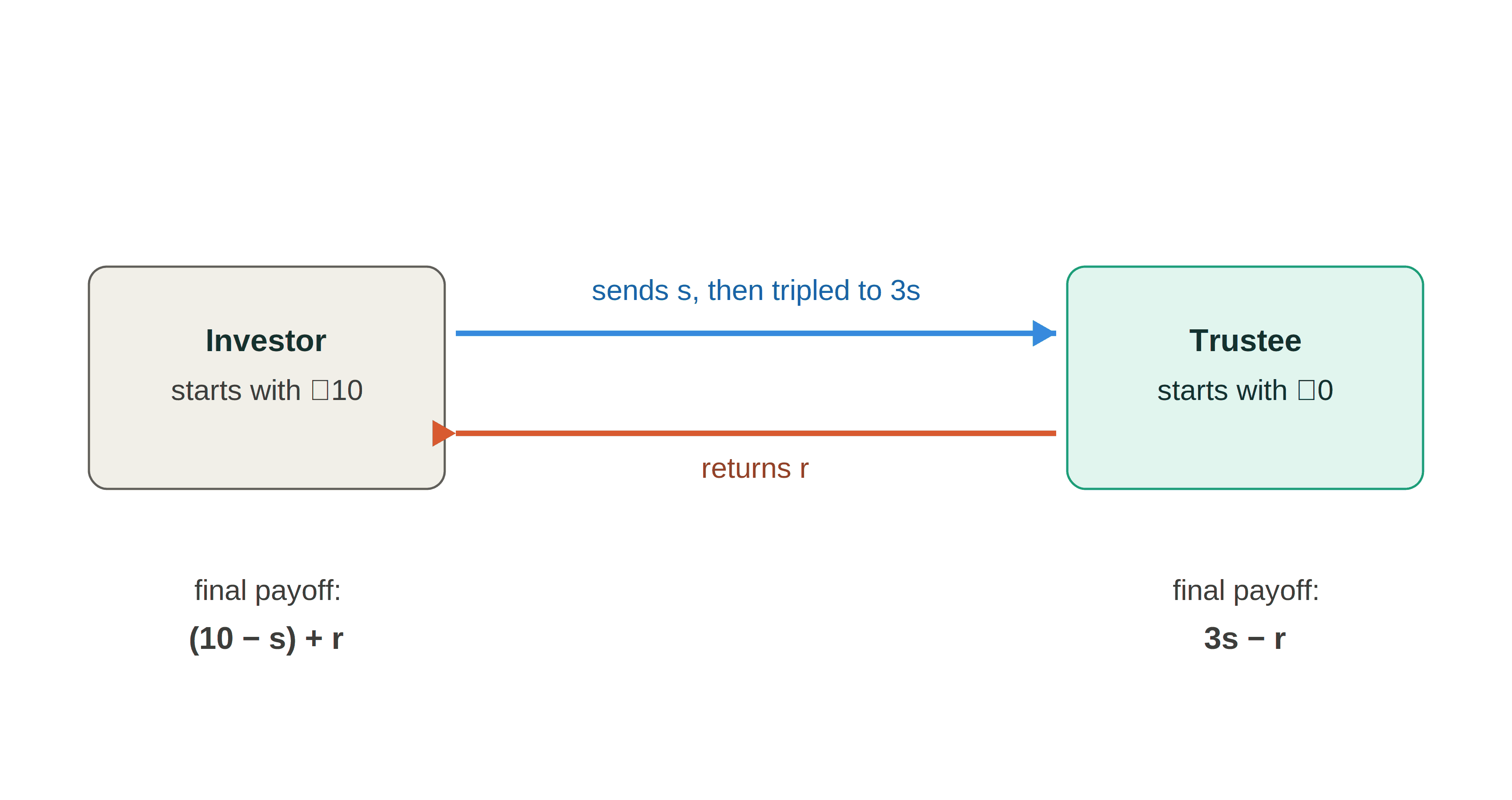
| Player | Final Payoff |
|---|---|
| Investor | |
| Trustee |
Worked example. Suppose the investor sends the full ₹10 (), which triples to ₹30 in the trustee's hands. If the trustee returns exactly half, , the investor ends with , an outright gain over their original ₹10, and the trustee keeps too, also a gain over receiving nothing. Both players end up better off than the ₹10 baseline, purely because trust was extended and reciprocated, a real, positive-sum outcome that backward induction says should never happen in a one-shot game with a self-interested trustee, since a self-interested trustee facing no future consequences should set every time.
One further distinction this design makes possible, worth having explicitly: the investor's decision to send money measures trust, willingness to make oneself vulnerable to another person's discretion, while the trustee's decision to return money measures trustworthiness, whether that vulnerability actually gets honored. The two turn out to be separable, measurable traits, not opposite ends of a single dial. A person can be highly trusting without being especially trustworthy themselves, or the reverse, and replications of this design across different countries have repeatedly found that average trust and average trustworthiness don't move together in any simple, predictable way.
Where this shows up in practice. The trust game has become one of the most widely replicated designs in experimental economics, run across dozens of countries and cultural contexts, and average return rates consistently land well below the fifty percent mark, meaning investors who send money are, on average, taking a real expected material loss to extend that trust in the first place. It's also directly relevant to real lending relationships: microfinance programs that rely on a first loan being extended to a borrower with no credit history at all are, structurally, running exactly this experiment with real money and real consequences.
Chapter 5Identity Economics: When Protecting Who You Are Outweighs What You'd Gain
The mechanism. Every model so far in this article still assumes a person's identity, their sense of which social category they belong to and how someone in that category should behave, plays no role in what they choose. George Akerlof and Rachel Kranton's 2000 paper, "Economics and Identity," argues this is a real, missing variable, not a sociological afterthought bolted onto economics, but something that belongs directly inside the utility function itself.
The formal model. A person's utility depends on their material payoff and on how far their actual behavior strays from the behavior prescribed for their self-identified category.
| Term | Meaning |
|---|---|
| Player 's overall utility, the actual quantity being maximized, combining ordinary material payoff with the psychological cost of straying from an identity's prescribed behavior | |
| The ordinary material payoff from taking action , exactly what a classical, identity-free model would compute on its own | |
| The action the person actually takes | |
| The social category the person identifies with | |
| The behavior prescribed, by social norm, for someone in category | |
| A distance function measuring how far the actual action strays from that prescription; larger deviations cost more | |
| How strongly this specific person identifies with the category, how much a violation actually stings |
Worked example. Consider someone who identifies strongly as environmentally conscious, with correspondingly high. Driving to a nearby errand instead of cycling saves fifteen minutes, worth, say, in convenience terms. But driving is a visible departure from , the behavior this person associates with their own identity, generating an identity cost of . Net utility from driving: . Cycling instead, despite the fifteen-minute cost, avoids that identity penalty entirely and comes out ahead. Nothing about the material convenience calculation changed, what changed the decision was a cost classical economics has no variable for at all.
Where this shows up in practice. Akerlof and Kranton's own paper applies this framework directly to three separate domains. In gender discrimination in the workplace, identity-based norms about which jobs are "appropriate" for which category of worker can persist even at a real material cost to the employer. In the economics of poverty and social exclusion, identifying with an excluded group can itself discourage behaviors, pursuing further education, taking a job outside the community, that would be read as a betrayal of that identity. And in the household division of labor, tasks get allocated by conformity to gendered identity norms rather than purely by comparative advantage or efficiency. In each case, the paper's own conclusion was consistent: adding identity to the utility function didn't just add texture, it substantively changed what the model predicted.
Chapter 6What Is Quantal Response Equilibrium?
The mechanism. Every model built so far in this article, and every model in the first article of this series, shares one quiet assumption: whoever you're interacting with reasons about the game exactly as well as the theory assumes they do. Richard McKelvey and Thomas Palfrey's 1995 paper drops that assumption entirely. Real opponents don't always pick the strictly best response, they pick better responses more often than worse ones, but with genuine, persistent noise, and critically, everyone in the game correctly anticipates that everyone else, themselves included, reasons this way too.
This is a different kind of imperfection from the bounded strategic reasoning already covered in Artha's earlier behavioral economics material, where players reason to a limited, finite depth about what others will do. Quantal response equilibrium isn't about reasoning depth at all. It's about precision, even a player reasoning to full depth still picks noisily, weighted toward better outcomes but never with certainty.
The formal model. The most common version, logit quantal response, converts payoffs into choice probabilities directly:
| Term | Meaning |
|---|---|
| The probability that player actually chooses action , this is the entire quantity the equation solves for | |
| The payoff to player from taking action | |
| A precision parameter: as , choices converge to ordinary, perfectly rational Nash equilibrium; as , every action becomes equally likely, pure noise |
Worked example. Consider a simple choice between two actions with payoffs and , a modest, not overwhelming, advantage for A. At :
Action A, despite being clearly better, only gets chosen about 73 percent of the time, not 100 percent. The remaining 27 percent isn't a modeling error to be explained away, it's the actual empirical pattern found in laboratory game data again and again: better options win out more often, but rarely with the certainty pure Nash equilibrium assumes, and every player in a QRE-consistent game is, correctly, expecting exactly this kind of noise from everyone else too.
Where this shows up in practice. Kaushik Basu's 1994 "traveler's dilemma" is the cleanest illustration of why this model was needed at all. Two travelers have identical, damaged luggage and are separately asked to name a repair cost between ₹2 and ₹100. Both get reimbursed at the lower of the two claims, with a small bonus paid to whoever claimed the lower amount and a small penalty charged to whoever claimed higher.
Standard backward-induction logic forces both players all the way down to naming ₹2, the worst possible outcome for both of them, since any higher claim can always be profitably undercut by the other player, a fact both players know, all the way down. Real players never do this. Monica Capra, Jacob Goeree, Rosario Gomez, and Charles Holt's 1999 experiment testing exactly this game found subjects claiming amounts far closer to the maximum than to ₹2, and much closer to what quantal response equilibrium actually predicts, once noisy, imperfect best-responding is built into the model properly, than to the stark, unanimous collapse pure game theory demands.
Chapter 7Five Places These Models Already Became a Product Feature
The free sample. Robert Cialdini's reciprocity research, now decades of replication deep, is close to a direct real-world test of Rabin's model: give someone something small and unsolicited, and the obligation to reciprocate is disproportionate to the gift's actual value. In one frequently replicated restaurant study, a waiter's tips rose 3 percent after giving diners one free mint with the bill, 14 percent after giving two, and 23 percent when a single mint was left first and a second one delivered moments later, as if on second thought. The Disabled American Veterans charity saw response rates to a donation mailer rise from 18 to 35 percent by including nothing more than a small sheet of personalized address labels. None of this works because the gift is valuable. It works because Rabin's model predicts it should, kindness perceived, however small, gets reciprocated even when reciprocating costs more than the original gift was worth.
The round-up-for-charity checkout prompt. "Round up your total to the nearest hundred for charity?" is warm-glow altruism made into a checkout-flow feature. A purely outcome-focused donor should be close to indifferent to whether their few rupees round up a fund that's already collecting from millions of shoppers, their specific contribution barely moves the total. The prompt keeps converting anyway, because the warm-glow term in Andreoni's model doesn't care about the total at all, it pays out on the act of giving, at the checkout counter, regardless of how large the pool already is.
The trust badge. E-commerce checkout pages are covered in small icons, security seals, money-back guarantees, "as seen in" media logos, precisely because online trust has to be manufactured before a single transaction has taken place, exactly the condition Berg, Dickhaut, and McCabe's experiment isolated. Industry checkout research (Baymard Institute) attributes conversion gains as high as 35 percent to better checkout design and visible trust elements combined, real money, resting on the same willingness to extend trust to a stranger before any history exists between them.
Identity-driven branding. Marketing's "self-congruity theory," the finding that consumers favor brands whose perceived identity matches their own self-concept, is close to a direct commercial application of Akerlof and Kranton's formal model. A product doesn't have to be objectively better to win a purchase, it has to read as consistent with who the buyer believes they are, which is precisely the term doing commercial work: choosing the identity-congruent option even at a price premium isn't irrational under this model, it's avoiding a cost classical marketing never had a name for.
Auction and mechanism design. Quantal response equilibrium is the one model in this article that isn't wielded against a consumer directly, it's a design tool. Auction designers, including those running large-scale online ad auctions, use QRE-style models specifically because bidders don't submit perfect best responses, and a mechanism designed assuming flawless rationality can be reliably gamed or can misprice outcomes when real, noisy bidders show up instead. This is the honest exception in the list: not a persuasion tactic aimed at an individual, but an acknowledgment, built into market design itself, that nobody plays perfectly, including the people the market was built for.
Chapter 8Conclusion & Key Takeaways
Five models, five different ways another person's presence changes what utility even means. Rabin's fairness equilibrium showed that intentions, not just outcomes, drive reciprocity, and that this isn't just a laboratory finding, it moved real wages and real effort by triple-digit percentages in an actual labor market. Andreoni's warm glow showed that giving survives both the free-rider problem and the crowding-out puzzle because part of its value never depended on the outcome at all, a fact a 50,000-person field experiment on matching donations confirmed directly. The trust game showed that cooperation between total strangers, with no reputation and no second chance, isn't a calculated bet, Berg, Dickhaut, and McCabe's own word for it was a "primitive," and that trust and trustworthiness are two separate things entirely. Identity economics showed that protecting a self-concept can outbid a better material deal outright, across discrimination, poverty, and the division of labor at home alike. And quantal response equilibrium closed the article by dropping the last hidden assumption sitting underneath every one of them, that whoever you're playing against reasons as precisely as the model does, a gap made vivid by travelers who refuse to race each other down to the worst possible outcome the way pure theory insists they must.
That last model is also the hinge this whole series turns on next. Every gap closed across these two articles, individual and social alike, still lives inside a controlled setting: one decision, one interaction, a handful of players who can at least in principle be watched directly. Article 3 removes that scaffolding entirely, and asks what happens once thousands of these same biased, reciprocal, identity-protecting, imperfectly-reasoning people all trade at once, inside a real market with a real price attached. The disposition effect will show loss aversion and regret avoidance turning up directly in real brokerage account data, selling winners too early and holding losers too long. Overconfidence in trading will show the planning fallacy priced into real portfolio returns. Noise trader risk and the limits of arbitrage will show why a market full of biased individuals doesn't simply get corrected by rational money arriving to fix it, sometimes rational money can't afford to try. And informational cascades will show how a room full of individually reasonable people, each one noisy in exactly the way quantal response equilibrium describes, can still end up producing a herd that's collectively very wrong. Article 3 is where everything this pair of articles built stops being a story about individual minds and becomes a story about what a price actually is.
| Takeaway | Why It Matters |
|---|---|
| Fairness depends on intentions, not just outcomes | Rabin's model rewards reciprocal kindness and reciprocal spite equally, since both involve two matching signs; a real labor market experiment found wages 140 percent above market rate drew effort 300 percent above the required minimum |
| Giving has a private payoff independent of the outcome | Warm-glow utility depends only on one's own contribution; a 50,083-person field experiment found a $3-for-$1 match raised no more money than a plain $1-for-$1 match, exactly what pure altruism can't explain |
| Trust between total strangers isn't calculated, it's foundational, and it's not the same thing as trustworthiness | Berg, Dickhaut, and McCabe eliminated every rational reason to trust in their design, reputation, precommitment, punishment, and people did it anyway; the two traits don't reliably move together across replications |
| Protecting an identity can beat a better deal outright | Akerlof and Kranton's model prices identity directly into utility, and their own paper applies it to discrimination, poverty, and household labor alike |
| Even a "perfectly reasoning" opponent isn't one | The traveler's dilemma shows real players refusing to race each other down to the worst possible outcome pure game theory demands, landing instead close to what quantal response equilibrium predicts |
| Every model in this article still lives inside a controlled setting | One interaction, a handful of players, conditions that can be observed directly; the next article removes that scaffolding and moves into real, priced markets |
Sources
Rabin, M. (1993). "Incorporating Fairness into Game Theory and Economics." American Economic Review, 83(5), 1281-1302; Dufwenberg, M., & Kirchsteiger, G. (2004). "A Theory of Sequential Reciprocity." Games and Economic Behavior, 47(2), 268-298; Fehr, E., Kirchsteiger, G., & Riedl, A. (1993). "Does Fairness Prevent Market Clearing? An Experimental Investigation." Quarterly Journal of Economics, 108(2), 437-459; Andreoni, J. (1990). "Impure Altruism and Donations to Public Goods: A Theory of Warm-Glow Giving." Economic Journal, 100(401), 464-477; Karlan, D., & List, J. A. (2007). "Does Price Matter in Charitable Giving? Evidence from a Large-Scale Natural Field Experiment." American Economic Review, 97(5), 1774-1793; Berg, J., Dickhaut, J., & McCabe, K. (1995). "Trust, Reciprocity, and Social History." Games and Economic Behavior, 10(1), 122-142; Akerlof, G. A., & Kranton, R. E. (2000). "Economics and Identity." Quarterly Journal of Economics, 115(3), 715-753; McKelvey, R. D., & Palfrey, T. R. (1995). "Quantal Response Equilibria for Normal Form Games." Games and Economic Behavior, 10(1), 6-38; Basu, K. (1994). "The Traveler's Dilemma: Paradoxes of Rationality in Game Theory." American Economic Review, 84(2), 391-395; Capra, C. M., Goeree, J. K., Gomez, R., & Holt, C. A. (1999). "Anomalous Behavior in a Traveler's Dilemma?" American Economic Review, 89(3), 678-690; Fehr, E., & Schmidt, K. (1999). "A Theory of Fairness, Competition, and Cooperation." Quarterly Journal of Economics, 114(3), 817-868; Güth, W., Schmittberger, R., & Schwarze, B. (1982). "An Experimental Analysis of Ultimatum Bargaining." Journal of Economic Behavior & Organization, 3(4), 367-388; Cialdini, R. B., Influence: The Psychology of Persuasion, general reference for the reciprocity marketing research cited above; Baymard Institute, ecommerce checkout and trust-element conversion research (industry research, not peer-reviewed)