A man is told, with total confidence, that this year's bonus is coming. Strong quarter, everyone said so, the number was practically a formality. Then it doesn't arrive.
He isn't poorer than he was last year. His salary, his savings, his actual wealth, none of it moved. And yet the disappointment lands like a real loss, not a missed extra, a loss, with all the sting that word implies. Ask him to explain why, and he can't, not in any way that maps cleanly onto "I have less money than before," because he doesn't. He has exactly what he's always had. What changed was never in his bank account. It was in his head, and it happened before the bonus was ever supposed to arrive.
That gap, between what a rational calculation says and what a person actually feels, is the entire subject matter of behavioral economics, a field built on one stubborn observation: classical economics assumes people are consistent, rational calculators of their own self-interest, and real people, demonstrably and repeatably, are not.
Not randomly irrational, that kind of noise cancels out in aggregate and gives a theory nothing to hold onto. Irrational in specific, patterned, mathematically describable ways, departures from rational choice precise enough to write down as formulas and test against real behavior, not just gesture at from anecdote. That's the actual claim the entire field is built on, and it's a far more testable, far more useful claim than "people are sometimes foolish."
Daniel Kahneman and Amos Tversky's 1979 paper is not merely well-regarded. It's the single most-cited article ever published in Econometrica, one of the two or three most prestigious journals in the discipline, and by a wide margin the most-cited paper to appear in any economics journal, full stop.
When Kahneman won the Nobel in 2002, the citation curve didn't just continue, it visibly kinked upward, a documented "Nobel bump" that held up even after researchers deliberately checked it against other 1979 Econometrica papers as a placebo. Very few ideas in economics have been tested, cited, re-tested, and cited again this many times, by this many people, for this long, and survived it this intact. Loss aversion, reference dependence, probability weighting: these aren't fringe theories waiting for validation. They are, by any reasonable measure, the most battle-tested descriptive model of human choice the field has ever produced.
And it still can't fully explain the man and his missing bonus. Prospect theory needs a reference point to work, that's the entire architecture, gains and losses only mean anything relative to something, and the model's own convention, inherited from how it's most often applied, is to treat that reference point as the status quo: what you already have, what you started the year with. But he didn't start the year with the bonus. He never had it. By the model's own bookkeeping, its disappearance should barely register, a forgone gain, not a loss. It doesn't feel that way, and prospect theory, taken purely on its own terms, has no clean account of why.
That's not a flaw exposed by some obscure edge case. It's a genuine, specific gap sitting inside the most successful model behavioral economics has ever produced, and it's not the only one.
What happens when someone doesn't just miss out on a good outcome, but has to sit with knowing the alternative they turned down would have paid off? Prospect theory is silent on that too, it was never built to compare a chosen outcome against a forgone one. What happens when the odds themselves aren't merely risky, unknown but describable, but genuinely unknowable, the kind of situation no probability distribution actually captures? Silent again. What happens when a person understands a temptation completely, sees it clearly, and still can't fully trust themselves around it? The model has no place in its structure for that battle to even occur.
Six separate models, developed across four decades by researchers working from inside the same tradition Kahneman and Tversky founded, were each built to close exactly one of these gaps. None of them replace prospect theory. Each one starts by taking it seriously enough to ask what, precisely, it still can't explain, and then goes and builds the missing piece.
Chapter 1Where Prospect Theory Stops Explaining Itself
| Gap in Prospect Theory | Which Model Closes It |
|---|---|
| Only compares what actually happened to your reference point, it has no way to account for what the road not taken would have given you | Regret Theory |
| Needs the odds to be knowable numbers to work with, even distorted ones, and has nothing to say when the odds themselves are a genuine mystery, not risky, just unknown | Ambiguity Aversion |
| Treats the reference point as something simply given in advance, usually your current wealth, and never explains how that reference point actually gets formed in someone's head | Kőszegi-Rabin (expectations-based reference points) |
| Assumes everyone who discounts the future steeply behaves identically, with no distinction between someone who sees their own future procrastination coming and someone who genuinely doesn't | Naive vs. Sophisticated Agents |
| Treats every choice as a simple preference, with no way to represent someone who is actively resisting a temptation and isn't certain they'll succeed | Temptation and Self-Control |
| Bends every probability by the same fixed formula regardless of context, and has no explanation for why one specific number in a side-by-side comparison is the one that grabs your attention | Salience Theory |
What Is Regret Theory?
The mechanism. Prospect theory evaluates an outcome against a reference point, typically the status quo. Regret theory, developed independently by Graham Loomes and Robert Sugden, and by David Bell, both in 1982, argues you evaluate an outcome against something more specific and more painful: the outcome you would have received had you chosen differently, in that same realized state of the world.
Pick the safe option and watch the risky one you passed up pay off, and you don't just miss a gain, you experience regret, a distinct negative feeling on top of the missed money. Pick the risky option and watch it beat the safe one, and you experience rejoice, a bonus positive feeling beyond the payoff itself.
| Formula | Meaning |
|---|---|
| The ordinary "choiceless" utility of the outcome actually received, exactly as expected utility theory, the classical model that multiplies each possible outcome by its probability and sums the results, would compute it | |
| A regret-rejoice function, added on top of ordinary utility. It treats gains and losses as exact mirror images of each other, , meaning whatever positive boost a win of a given size gives you, an equivalent loss subtracts the exact same amount before the asymmetric weighting is applied: positive when the chosen option beat the forgone one in that state, negative when it lost to it |
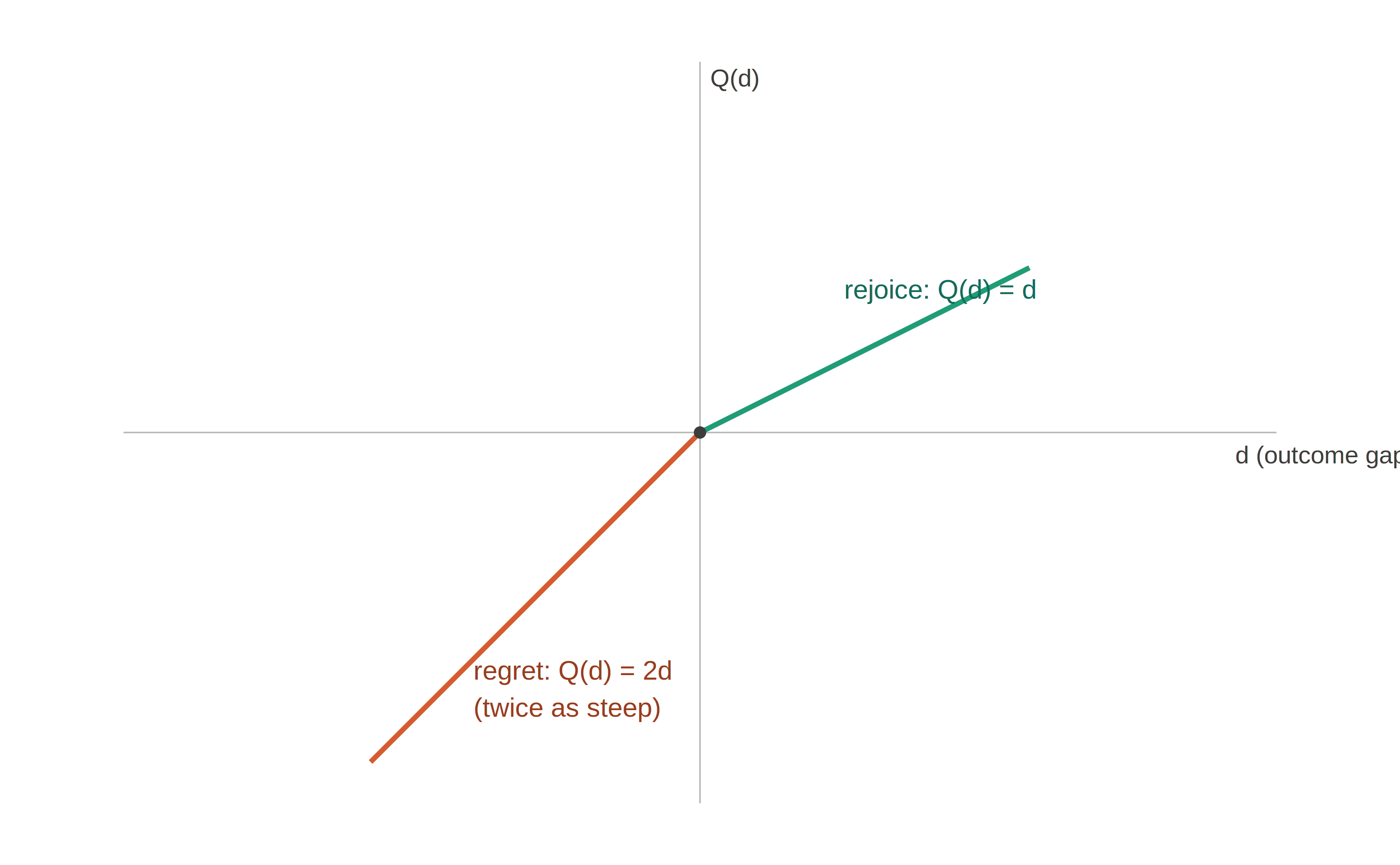
Worked example. Take a simple regret-rejoice function where rejoice counts at face value and regret is weighted twice as heavily, mirroring the same kind of asymmetry loss aversion built into prospect theory: for , and for , exactly the kink shown above. Someone chooses a certain ₹50 over a risky option. In the state of the world where the risky option would have paid ₹100:
Compare that to simply having received ₹50 with no counterfactual in play at all, the missed ₹100 doesn't just fail to help, the regret term actively drags the evaluated value of that outcome below zero, even though ₹50 in hand is objectively a gain. That's the entire mechanism: not "I got less than I hoped," but "I got less than I would have gotten."
Why it matters, and its real theoretical cost. Regret theory explains a well-documented pattern called the Allais paradox, where people's choices between two gambles flip in a way that breaks a basic consistency rule classical decision theory otherwise insists on, along with a range of other preference reversals that prospect theory, despite everything else it explains, still can't fully capture. It does this by giving up something classical economics treats as nearly sacred: transitivity, the assumption that if you prefer A to B and B to C, you prefer A to C.
Loomes and Sugden showed, using a three-option cycling example, that regret-based reasoning can produce genuine preference cycles, A over B, B over C, but C over A, something no transitive theory, prospect theory included, can ever produce.
Where this shows up in practice. This isn't just a laboratory curiosity. Shefrin and Statman's own 1985 paper identifying the disposition effect, the well-documented tendency of investors to sell winning stocks too early and hold losing ones too long, names regret avoidance as one of exactly four psychological mechanisms behind it, alongside loss aversion, mental accounting (treating money differently depending on which mental "bucket" it's assigned to, rather than as simply interchangeable), and self-control. Selling a losing stock means locking in the regret of having bought it; holding it lets you avoid confronting that regret, even at real financial cost. Article 3 in this series covers the disposition effect's formal treatment directly.
Chapter 3What Is Ambiguity Aversion?
The mechanism. Every model discussed so far, including prospect theory itself, assumes you know the probabilities involved, you might distort them psychologically, but a known number is being distorted. Daniel Ellsberg's 1961 paper posed a sharper problem: what happens when the odds themselves are genuinely unknown, not risky, but ambiguous?
His classic setup: Urn A contains 50 red balls and 50 black balls, known exactly. Urn B contains 100 balls, red and black in some unknown proportion.
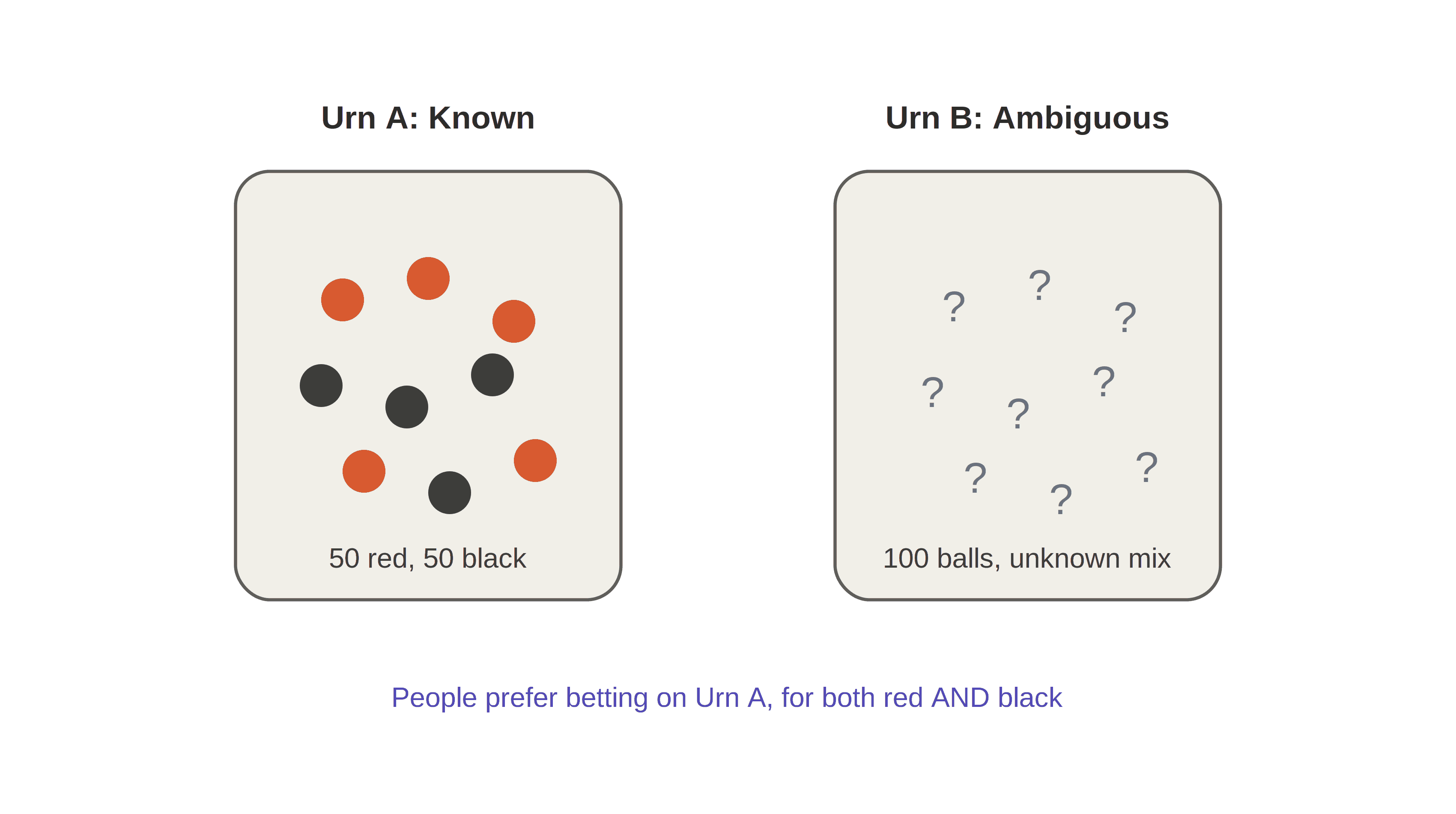
Bet on red from either urn, and people overwhelmingly prefer Urn A. Bet on black from either urn, and they still prefer Urn A. That's the paradox: for the preference over red to make sense probabilistically, you'd need to believe Urn A has more red balls than Urn B; for the preference over black to make sense, you'd need to believe Urn A has more black balls too. Both can't be true of the same urn.
People aren't reasoning about probabilities at all, they're avoiding the urn where the probabilities are simply unknown.
The formal model. David Schmeidler's 1989 Choquet Expected Utility framework fixes this by replacing ordinary probabilities, which must sum to exactly 1 across all outcomes, with capacities, non-additive weights that are allowed to sum to less than 1, with the shortfall representing the ambiguity itself.
| Formula | Meaning |
|---|---|
| A capacity: like a probability measure, but not required to be additive. can be less than 1 for the ambiguous urn, reflecting genuine unresolved uncertainty rather than a specific belief | |
| The Choquet integral, a generalized expectation computed against this non-additive capacity rather than an ordinary probability distribution |
Worked illustration. For the known urn, , summing to exactly 1, an ordinary probability measure. For the ambiguous urn, a Choquet-consistent representation might assign and , summing to only . The missing isn't assigned to either outcome, it represents the ambiguity itself, and because both bets on the ambiguous urn get evaluated against a lower effective weight than the corresponding bet on the known urn, the model correctly predicts the known urn wins both comparisons, exactly the pattern Ellsberg observed and ordinary probability theory cannot explain.
A closely related model worth naming directly: Gilboa and Schmeidler's 1989 Maxmin Expected Utility represents ambiguity as a whole set of possible probability distributions rather than one capacity, and evaluates each option by its worst-case expected utility across that set, a more pessimistic, robustness-first way of formalizing the same underlying aversion to not-knowing.
Where this shows up in practice. Insurance markets price ambiguous risks (novel catastrophic events, newly emerging liabilities) at a premium well above their best actuarial estimate, insurers are demanding compensation for ambiguity itself, not just for risk. This is a genuine, active research area rather than a settled field application, and I'd rather say that plainly than manufacture a tidier success story than the literature actually supports.
Chapter 4Reference-Dependent Preferences from Expectations: Where the Reference Point Actually Comes From
The mechanism. This is where the man from the opening of this article gets his explanation. Prospect theory needs a reference point to work, but never specifies where it comes from, most applications simply assume it's the status quo. Botond Kőszegi and Matthew Rabin's 2006 model, published in the Quarterly Journal of Economics, closes that gap directly: the reference point is a person's own rational expectations about the outcome, not what they currently have, but what they had reasonably come to expect.
The formal model. Total utility splits into two separate pieces:
| Formula | Meaning |
|---|---|
| Ordinary "consumption utility", the standard, reference-independent value of the outcome , exactly what classical economics would compute | |
| "Gain-loss utility", evaluated using a prospect-theory-shaped value function, but applied to the gap between the outcome and the person's expectation , not the gap from a fixed status quo |
The reference point itself is defined through what Kőszegi and Rabin call a "personal equilibrium," a stable point where the person's expectations and their actual optimal choice, given those expectations, are mutually consistent.
Worked example. The man from the opening expected a ₹10,000 bonus with near-certainty. Under classical status-quo reference dependence, receiving ₹0 is disappointing but not a "loss" in the prospect-theory sense, since his salary itself hasn't changed. Under Kőszegi-Rabin, the expectation of ₹10,000 is the reference point, so receiving ₹0 registers as a loss of ₹10,000, evaluated through the same steep, loss-averse value function used for actual reference dependence, roughly 2.25 times as painful as an unexpected ₹10,000 gain would have been pleasant. This is precisely why revoking an expected raise or bonus provokes a reaction wildly disproportionate to the actual money involved, the pain isn't calibrated to wealth lost, it's calibrated to expectation violated.
Where this shows up in practice. Kőszegi and Rabin's own later papers (2007, 2009) extend this into asset pricing and risk attitudes directly, and subsequent empirical work, including laboratory tests of sellers' willingness-to-accept prices, has tested the "personal equilibrium" prediction directly against real pricing behavior. It's a genuinely active line of applied research, not yet a single canonical field case study, and I'd rather flag that honestly than invent one.
Chapter 5Naive Agents Don't Buy Their Own Cure
The mechanism. Before getting to naive and sophisticated agents specifically, the phenomenon both types share is worth explaining properly rather than just naming. Hyperbolic discounting describes a specific, reproducible inconsistency in how people value the future: the discount applied to a delay isn't constant, it's steepest for the gap between right now and the very near future, and flattens out considerably for any delay further out than that.
The classic illustration makes this concrete. Offered ₹100 today or ₹110 tomorrow, most people take the ₹100 today, unwilling to wait a single day for 10 percent more. But offered the identical choice thirty days out, ₹100 in thirty days or ₹110 in thirty-one days, the same people typically wait and take the ₹110. The gap being waited for is identical in both cases, exactly one day, and the amounts on the table are identical too. What changed is only whether that one-day gap starts today or starts a month from now. A constant, classical discount rate can never produce that reversal, whatever rate makes someone patient about day 30-to-31 should make them equally patient about day 0-to-1. Something in the model has to bite specifically on the jump from "now" to "not now," and nowhere else. That something reaches its most commonly used economic formalization in David Laibson's 1997 quasi-hyperbolic, or beta-delta, model, the same structure used below.
What that model doesn't address on its own is a crucial second dimension: does the person know they'll behave this way?
Ted O'Donoghue and Matthew Rabin's 1999 paper, "Doing It Now or Later," draws a sharp line between two types of present-biased agents. A sophisticated agent correctly anticipates that their future self will also be present-biased, and can plan around it. A naive agent believes their future self will act patiently, even though it won't, and therefore never sees the need for commitment devices at all.
The formal model. Both types share the same quasi-hyperbolic discount structure used to model this kind of present bias generally, , an ordinary discount factor applied per period, with an extra penalty that bites specifically on the gap between right now and one period ahead, but differ in their belief about their own future :
| Type | Belief About Future Self |
|---|---|
| Sophisticated | (correctly predicts their own future present bias) |
| Naive | (wrongly believes their future self will discount patiently, with no present bias at all) |
| Partially naive | (aware they'll be somewhat present-biased, but underestimates how much) |
Worked example. A task with immediate cost 7, delayed benefit 10 (received one period after completion), , .
Evaluated right now, with the cost immediate and only the benefit discounted:
Negative. Doing it today looks like a bad idea.
Evaluated from a distance, planning today to do it at some future date, both the cost and the benefit are future relative to right now, so both get the same discount applied equally:
Positive. Planned in advance, the exact same task looks worth doing.
That gap, negative when it's actually time to act, positive when it's still comfortably in the future, is the entire mechanism of procrastination. Tomorrow always looks like a good day to finally do it. When tomorrow arrives, it's evaluated fresh using the formula, and it's negative again, so it gets pushed one more day. Forever, unless something intervenes.
The case study, and its failure counterpart. DellaVigna and Malmendier's 2006 study of health club contracts found members paying an average monthly fee well above the pay-per-visit rate they'd actually have paid given their real attendance, and continuing to hold that contract for months after a cheaper pay-as-you-go option would have cost less. That's not irrational spending, it's a naive agent's own prediction failure, made visible in a billing statement: the version of themselves who signed the contract genuinely believed the version who'd show up three times a week.
The uncomfortable flip side: knowing the fix doesn't guarantee the fix gets used, even when it's offered directly. Ashraf, Karlan, and Yin's 2006 field experiment designed a real commitment savings account for a Philippine bank, specifically for people who wanted to restrict their own future access to their savings, and offered it directly to 710 existing bank clients. Only 202 of them, 28.4 percent, actually opened the account. The product worked exactly as designed for the people who took it. The theory was right. What the number quietly suggests is that a meaningful share of the people who could have benefited most, simply didn't recognize themselves in the offer.
Chapter 6Temptation and Self-Control: When Just Having the Option Makes You Worse Off
The mechanism. Faruk Gul and Wolfgang Pesendorfer's 2001 Econometrica paper asks a question standard choice theory can't even pose: can someone be made worse off by simply having more options available, even if they never choose the tempting one? Classical economics assumes more choice is always weakly better, you can always just ignore the option you don't want. Gul and Pesendorfer show this is false whenever resisting a temptation itself carries a psychological cost.
The formal model. Rather than modeling preferences over single outcomes, this model works over entire sets of available alternatives:
| Formula | Meaning |
|---|---|
| The full set of alternatives available, the actual menu being offered, not just the item eventually chosen | |
| "Commitment utility", how much the person genuinely values option from a considered, long-run perspective | |
| "Temptation utility", how strongly pulls at the person in the moment, independent of whether it's actually good for them | |
| The pull of the single most tempting item on the menu, subtracted off as the cost of resisting it, even when it isn't chosen |
Worked example. A restaurant menu with only a salad option: , . Utility of the meal: .
Now add a rich dessert to the same menu: (it's genuinely not what they'd choose to value long-run), but (it's viscerally tempting in the moment). The person still orders the salad, their choice hasn't changed at all. But their utility from the meal is now . Simply having the dessert on the menu, even while never ordering it, dropped their utility from 5 to 2, purely from the cost of resisting it.
Where this shows up in practice. This is the formal foundation behind an entire category of real behavior classical models can't explain: people who deliberately keep tempting foods out of the house, who choose the gym membership with fewer visible mirrors, who ask a restaurant to remove the bread basket before they're tempted, all while agreeing, if asked directly, that they'd never actually eat the bread. It also underlies pre-commitment retirement products, locking funds away specifically so the option to spend them isn't sitting on the menu at all, a market genuinely built on this exact mechanism.
Chapter 7Salience Theory: Which Payoffs Actually Grab Your Attention
The mechanism. Prospect theory's probability weighting function distorts probabilities uniformly, small ones get overweighted, large ones underweighted, regardless of context. Pedro Bordalo, Nicola Gennaioli, and Andrei Shleifer's 2012 Quarterly Journal of Economics paper argues something more specific happens first: attention itself gets pulled toward whichever payoff stands out most sharply in that particular context, and that payoff gets overweighted, whichever one it happens to be.
The formal model. A payoff's salience is defined by contrast against the other payoffs available in the same comparison:
| Formula | Meaning |
|---|---|
| The salience of payoff relative to some reference payoff (typically the corresponding payoff in an alternative option being compared) | |
| A small constant preventing division by zero when both payoffs are near zero | |
| Effect | Payoffs ranked as more salient receive a boosted decision weight; the same payoff can be salient in one comparison and unremarkable in another, since salience is defined by contrast, not by the payoff's absolute size |
Worked example. Comparing two insurance policies, one with a small, everyday-relevant deductible difference, one with a rare, catastrophic payout difference. The catastrophic payoff, precisely because it's so different in percentage terms from anything else in the comparison, becomes highly salient and gets overweighted, which is exactly why people routinely overpay for low-probability, high-drama coverage (extended warranties, flight-delay insurance) while underinsuring against genuinely likely, less dramatic risks. The true probability hasn't changed; what changed is which number is grabbing attention in that specific side-by-side comparison.
Where this shows up in practice. Bordalo, Gennaioli, and Shleifer's own companion paper extends the same mechanism to ordinary consumer choice, explaining decoy effects, where adding a deliberately unattractive third option to a menu makes one of the original two look better by contrast, even though nothing about that original two actually changed, and to financial markets, explaining why investors overreact to unusually large, attention-grabbing recent returns. It's a genuinely current, still-active research program, and it offers something the other five models here don't: a formal account of which bias gets triggered depending on what's actually being compared side by side, not just that biases exist.
Chapter 8Where This Gets Used Against You: Three Real Products, and a Few More
Every model in this article is abstract until it shows up in something you've actually signed up for. What's worth sitting with isn't that these biases exist, that case was already made. It's that somebody else already knows about them too, and has built a business on that knowledge.
The credit card minimum payment. Neil Stewart's 2009 study in Psychological Science analyzed 248 real UK credit card statements and found something genuinely uncomfortable: cardholders shown a minimum payment figure paid roughly 70 percent less toward their balance than cardholders who weren't shown one, enough to potentially double the total interest paid over the life of the debt. The finding has since been replicated in the US, Mexico, and Brazil.
Technically, this is an anchoring effect, a printed number pulling behavior toward it, the kind of bias covered in Artha's earlier behavioral economics material rather than one of the six models built out in this article. But it compounds directly with one of them: a naive agent, in O'Donoghue and Rabin's terms from earlier in this piece, believes they'll pay off the balance soon regardless, which removes any internal resistance to anchoring on that minimum figure in the first place. A sophisticated agent, aware of their own future behavior, has more reason to actively fight the anchor. The bias and the blind spot reinforce each other.
The inflated "regular price." Bordalo, Gennaioli, and Shleifer's own follow-up research on salience documents that a substantial share of retail revenue in some sectors comes from goods sold "on sale," where the original listed price was set high specifically so the eventual markdown would be large and visually salient, not because the discounted price reflects the item's actual market value.
The same research names "shrouded attributes," costs deliberately kept less visible than the headline price, foreign transaction fees, annual charges disclosed in fine print, the ongoing interest rate on a card whose sign-up bonus is what actually got advertised. The bonus is salient by design. The ongoing cost is salient by nobody's design at all, which is precisely the point.
Buy now, pay later. A newer product, but with real research already behind it. Studies reviewing BNPL adoption have reported associations with increased spending frequency and amount, along with higher rates of missed payments, and some of this has been traced to a reduction in what researchers call the "pain of paying," splitting a purchase into small, deferred instalments lowers the immediate psychological cost of buying something, even though the total cost hasn't changed at all.
That's not the exact formal apparatus Gul and Pesendorfer built, but it's the same underlying territory their model exists to describe: a purchase structured specifically to lower the felt cost of resisting it, whether or not the buyer would say, if asked directly, that they were tempted at all.
A few more patterns worth naming quickly. Promotional interest rates that quietly revert to a much higher standard rate once the introductory window closes lean on the same mechanism Kőszegi and Rabin described earlier in this piece, the low rate becomes the expected reference point, and its disappearance can register as a loss even though nothing beyond the introductory period was ever actually promised. Countdown timers and "only 2 left" messaging at checkout are a direct, if informal, appeal to the same anticipated regret this article covered earlier, the fear of choosing not to buy and later discovering the alternative would have sold out. Free trials that convert into paid subscriptions look, at first glance, like a simple naive-present-bias story, sign up believing cancellation will be easy, then don't follow through. Recent research complicates that in a genuinely interesting way: much of the population caught by auto-renewal turns out to be sophisticated, fully aware they're likely to procrastinate, and subscribing anyway, because remembering to act before a deadline is its own separate cost, distinct from simply misjudging one's own future willpower.
Chapter 9Every Model in This Article Assumed You're Alone
Every one of the six failures modeled above, mispriced regret, misjudged ambiguity, a reference point built from expectation instead of history, a plan undone by tomorrow's version of yourself, a menu that costs you something just by existing, a payoff that grabs your attention for reasons that have nothing to do with its odds, happens entirely inside one head. None of them needed anyone else to be true.
That's not a limitation of the six models. It's a boundary they were built to respect, deliberately isolating individual choice from social complication so each mechanism could be pinned down cleanly. But it means an entire category of real behavior is still sitting untouched: what happens the moment your decision depends on what someone else does, or believes, or is owed. Fairness toward a stranger. Trust extended before it's earned. An identity you're protecting that has nothing to do with the payoff on the table. Prospect theory couldn't explain any of that either, and neither can its six extensions here, because the object being modeled is still, stubbornly, a single mind.
The next article puts a second person in the room.
Chapter 10Conclusion & Key Takeaways
Six models, six specific answers to six specific questions prospect theory's own architecture couldn't reach on its own. Where a reference point actually comes from, rather than just being assumed. What a forgone alternative costs a person even when it was never chosen. What genuine not-knowing does to a decision that ordinary risk doesn't. Why a plan made today about tomorrow rarely survives contact with tomorrow itself. What an option costs simply by sitting on the menu, whether or not it's ever picked. Which specific number in a side-by-side comparison ends up running the show. None of these six models revise prospect theory or compete with it. Each one covers ground the 1979 model was never built to reach, which is precisely why all six can be true at once, in the same head, about the same decision, without contradicting each other or the theory they extend.
What ties them together, and what makes this a natural stopping point rather than an arbitrary one, is the boundary all six still share: one mind, deciding alone, with nothing at stake that depends on another person's choice, belief, or claim on the outcome. That boundary is the actual subject of Article 2. The formal tools change entirely once a second party enters the picture, fairness toward someone you'll never meet again, generosity extended with nothing promised back, trust handed over before anyone's proven it's warranted, an opponent across the table who isn't reasoning perfectly either. Prospect theory has nothing to say about any of that, and neither does anything covered in this article, both were built to model a single decision-maker, and a single decision-maker is what they'll only ever explain.
Article 3 closes the arc a level further out still: not one mind, not two minds negotiating, but thousands of minds, each carrying some version of the biases covered across this pair of articles, meeting inside an actual price mechanism, where their individual mistakes stop being private and start moving what an asset is actually worth.
| Takeaway | Why It Matters |
|---|---|
| Prospect theory's gaps are specific, not vague | Each model here answers a precise question prospect theory's own structure can't: where the reference point comes from, what happens under genuine ambiguity, what a temptation costs even when resisted |
| Regret theory compares outcomes to what you would have gotten, not just to a reference point | And it pays a real theoretical price for that power: it gives up transitivity, something almost no other model in economics is willing to sacrifice |
| Ambiguity aversion is mathematically distinct from risk aversion | Schmeidler's capacities can sum to less than 1, formally representing "I don't know" as something other than a probability, which ordinary expected utility has no way to express at all |
| The reference point isn't given, it's earned through expectation | Kőszegi-Rabin's personal equilibrium explains why a cancelled expected bonus hurts far more than classical wealth accounting would predict |
| Naive agents don't buy the products that would fix their own bias | Gym members systematically overpay for contracts they won't use enough to justify; even a well-designed commitment savings product, offered directly, was accepted by only 28.4 percent of those who received it |
| Having an option can make you worse off, even unchosen | Gul-Pesendorfer's model is the first to formally price the cost of resisting temptation, not just the cost of giving in to it |
| Which bias fires depends on what's being compared, not just what's being weighed | Salience theory is the only model here that predicts which distortion appears in a specific side-by-side choice, not just that distortion exists in general |
| This article covered one mind; the next covers two or more | Every model above assumed a solitary decision-maker; the next article begins exactly where that assumption stops holding |
Sources
Kahneman, D., & Tversky, A. (1979). "Prospect Theory: An Analysis of Decision Under Risk." Econometrica, 47(2), 263-291; Loomes, G., & Sugden, R. (1982). "Regret Theory: An Alternative Theory of Rational Choice Under Uncertainty." The Economic Journal, 92, 805-824; Bell, D. E. (1982). "Regret in Decision Making Under Uncertainty." Operations Research, 30(5); Shefrin, H., & Statman, M. (1985). "The Disposition to Sell Winners Too Early and Ride Losers Too Long." The Journal of Finance, 40(3), 777-790; Ellsberg, D. (1961). "Risk, Ambiguity, and the Savage Axioms." Quarterly Journal of Economics, 75(4), 643-669; Schmeidler, D. (1989). "Subjective Probability and Expected Utility Without Additivity." Econometrica, 57(3), 571-587; Gilboa, I., & Schmeidler, D. (1989). "Maxmin Expected Utility with a Non-Unique Prior." Journal of Mathematical Economics, 18(2), 141-153; Kőszegi, B., & Rabin, M. (2006). "A Model of Reference-Dependent Preferences." Quarterly Journal of Economics, 121(4), 1133-1165; O'Donoghue, T., & Rabin, M. (1999). "Doing It Now or Later." American Economic Review, 89(1), 103-124; DellaVigna, S., & Malmendier, U. (2006). "Paying Not to Go to the Gym." American Economic Review, 96(3), 694-719; Ashraf, N., Karlan, D., & Yin, W. (2006). "Tying Odysseus to the Mast: Evidence from a Commitment Savings Product in the Philippines." Quarterly Journal of Economics, 121(2), 635-672; Gul, F., & Pesendorfer, W. (2001). "Temptation and Self-Control." Econometrica, 69(6), 1403-1435; Bordalo, P., Gennaioli, N., & Shleifer, A. (2012). "Salience Theory of Choice Under Risk." Quarterly Journal of Economics, 127(3), 1243-1285