Russia's Internet Research Agency spent an estimated $46,000 on Facebook ads before the 2016 US election. The Trump and Clinton campaigns spent $81 million between them on the same platform, in the same race. That $46,000 bought a tiny fraction of what the two campaigns spent, and it wasn't even the operation's main channel: the IRA's real reach came from roughly 80,000 organic posts across 120 fake pages, which Facebook itself estimated were shared, liked, and re-shared widely enough to have been served to as many as 126 million people, a separate, larger effort from the ads, run by the same operation, for a fraction of what either campaign spent on advertising alone.
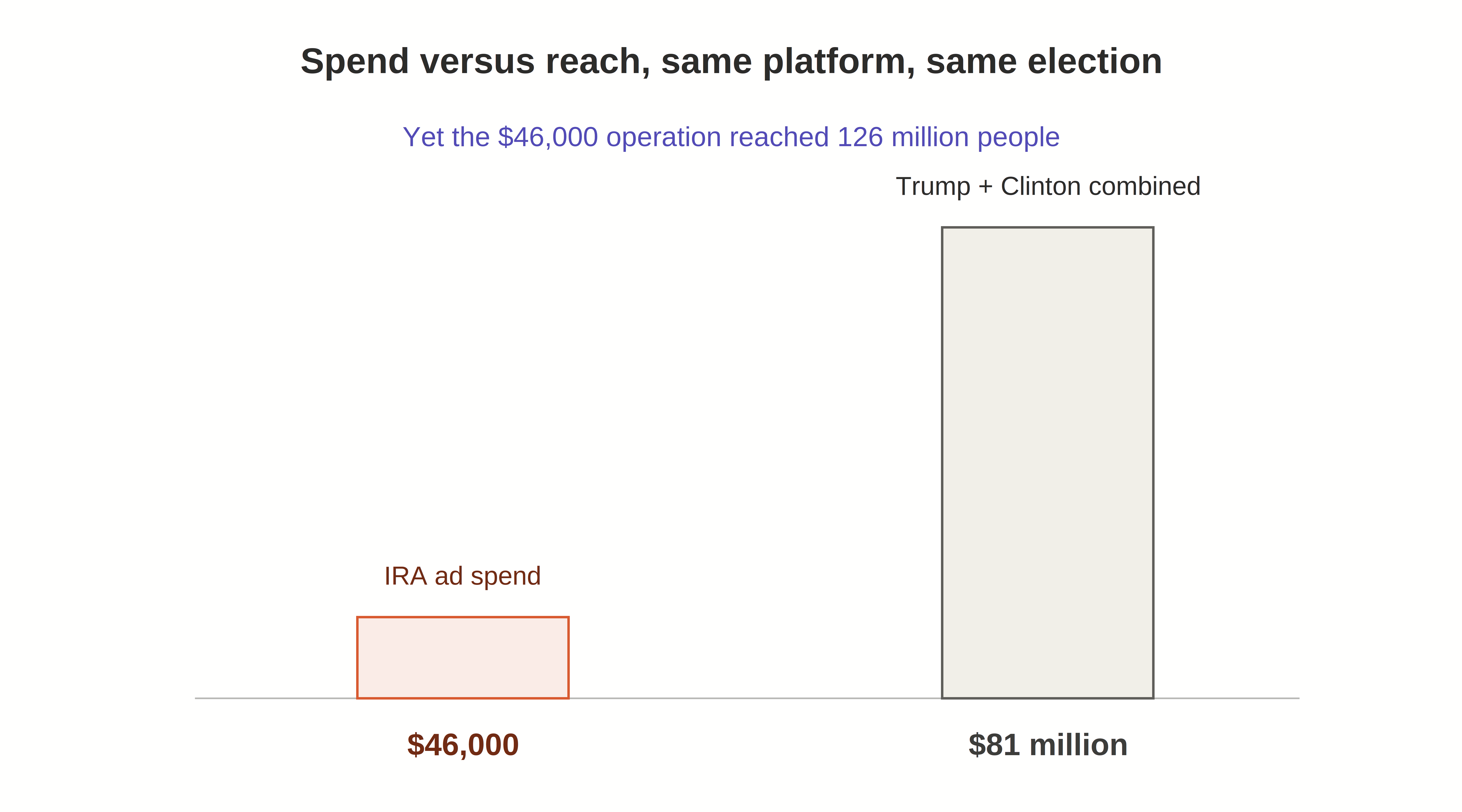
That gap, between what was spent and what it reached, is the right place to start. This piece has two jobs, kept apart rather than let one borrow the other's authority:
- The mechanics: what data actually gets collected, on far more than just registered voters, through which channels, sold by which named companies, and exactly how raw data becomes a targeting decision.
- The record: eight documented cases across countries and platforms, plus freebies and subsidies as their own category, each tested against one question: is the tactic confirmed, and is its effect actually proven? Across nearly every case here, those are two different answers.
One distinction matters enough to state before anything else: a tactic hitting its own measurable target, an email subject line raising donations, a ballot position shifting vote share in a studied race, is a genuinely different claim from a tactic deciding who won a contested election. This piece proves plenty of the first kind. It's the second kind, the one every headline actually cares about, that turns out to be so rarely provable at all.
Where the record clearly points one way, this piece says so plainly. But it holds every government, party, and platform to the identical standard regardless of ideology, because that's the only version of "critical" that means anything here.
Why This Actually Works on People?
Four mechanisms explain nearly everything that follows, worth naming once, together, rather than leaving implied across a dozen case studies:
- Identity comes before facts. Dan Kahan's research on identity-protective cognition finds people reason to defend their group identity, not to find the truth. People who read pro-Republican fake news in 2016 had, in most cases, already picked their candidate first. Disinformation mostly reinforces a side already chosen, it doesn't convert. This is Akerlof and Kranton's Identity Economics from this series' second article, running on political belief instead of a purchase decision.
- Repetition makes a claim feel truer, regardless of accuracy. The illusory truth effect: encountering a statement more than once, even incidentally, makes it feel more true the second time. This is the exact mechanism Russia's "firehose of falsehood" model was built to exploit, familiarity does persuasive work whether or not the claim is accurate.
- Losing something hurts more than never having it. The idea this whole series is built on. A subsidy, once granted, becomes a reference point, and withdrawing it registers as loss, not a foregone bonus. It's also why negative political messaging reliably outperforms positive messaging of equal informational content.
- Corrections rarely catch up to what they're correcting. The Continued Influence Effect: in the founding 1994 study, over 90 percent of people still referenced discredited information after receiving and accepting a correction. And most people never see the correction at all: over half of politically engaged readers seek out sources that already agree with them, versus only 22 percent who seek out challenging ones.
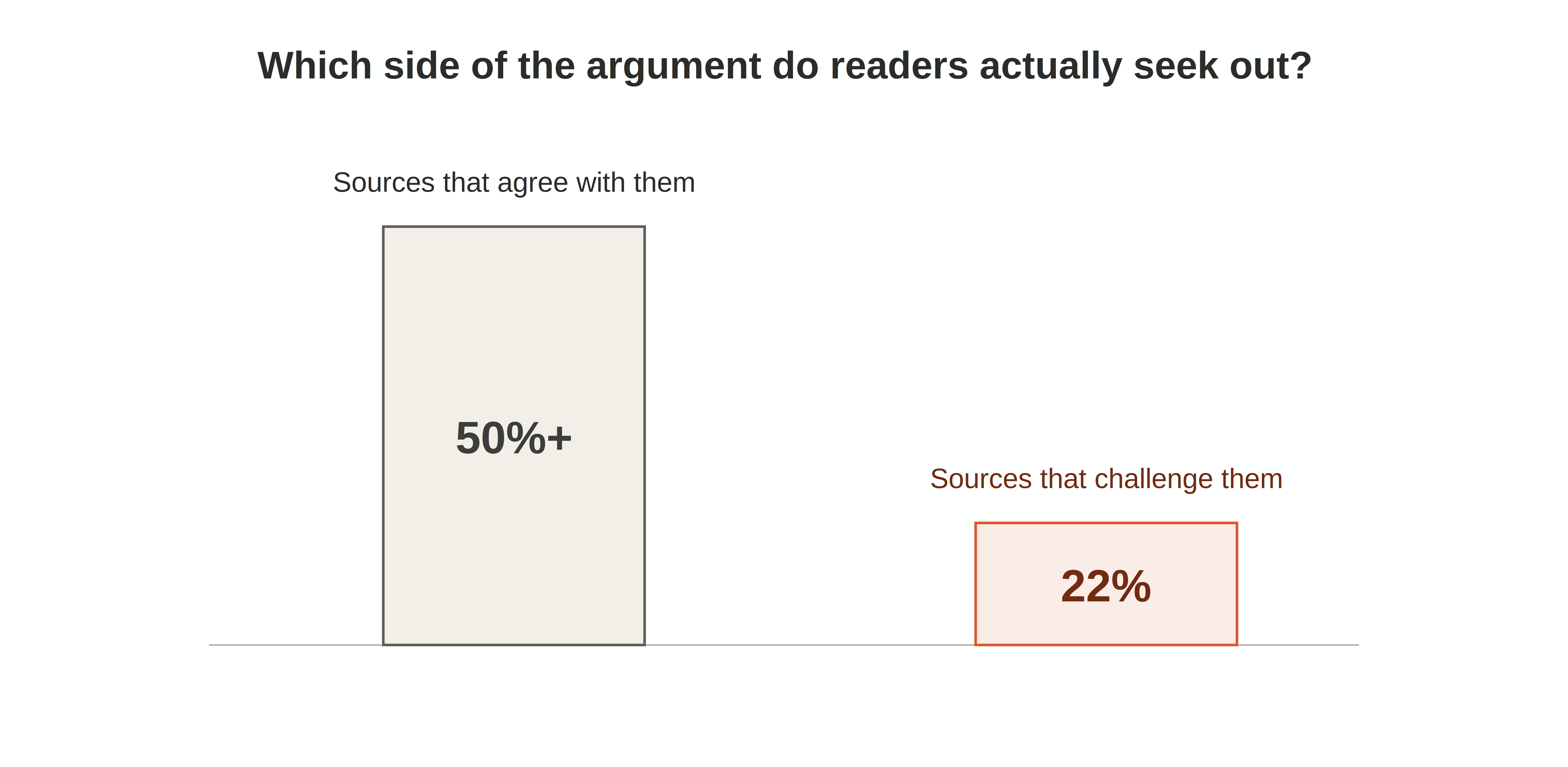
Put together: identity decides which claims get a hearing, repetition makes the survivors feel truer, loss aversion makes withdrawal hurt more than absence ever did, and the correction has to fight through a mind that prefers its first, coherent, wrong answer, delivered to an audience that mostly never sees the correction to begin with.
Chapter 1Part One: The Real Toolkit
What Data Actually Gets Collected, and on Whom
"Voter" undersells this. The identical pipeline below targets registered voters, but also donors being scored for how much they'll give, volunteers being recruited, and, in operations like Russia's, entire populations who were never being asked to vote at all, only to feel something and share it. Keep that broader frame in mind through the rest of this section.
| Stage | What Happens | Who Actually Does It |
|---|---|---|
| 1. The base file | Public government record: name, address, age, district, party registration where collected, turnout history. Never who someone actually voted for. | State election offices; L2, TargetSmart, Catalist, Data Trust, Aristotle |
| 2. Commercial enrichment | Religion, occupation, net worth, hobbies, inferred medical conditions, even which ad medium persuades this specific person best | i360 (Koch-backed, up to 1,800 data points per person); L2's "Voter Dictionary"; TargetSmart |
| 3. Predictive modeling | Turnout likelihood, partisan lean, issue-specific persuasion scores, or, for donors, a giving-likelihood score | Campaign data science teams, vendor modeling products |
| 4. Onboarding | Matching the scored record to a real, ad-targetable identifier, a device ID, IP address, hashed email | El Toro, advertising 95 percent match confidence |
| 5. Deployment | Targeted ads, tailored mail and calls, canvasser routing, geofenced targeting around physical venues | DSPolitical (advertised targeting voters in line to vote) |
Three details worth knowing beyond the table:
- i360 doesn't just sell data. The Kochs subsidize it directly, deliberately undercharging allied campaigns and groups like the NRA, treating it as ideological infrastructure rather than an ordinary product.
- L2's "Voter Dictionary" gets specific enough to include named hobby categories like "interest in woodworking," alongside net worth and inferred medical conditions.
- Onboarding, stage four, is the step almost nobody outside the industry has heard of, yet it's the one that turns a government record into something an ad platform can actually fire an impression at.
DSPolitical's polling-line targeting deserves the same honesty applied everywhere in this piece: it was documented and marketed. Whether any campaign ever used it closely enough to a contested result to matter isn't something any public record confirms. The tool existed. Whether it swung anything is a separate, unanswered question.
Dark Posts: The Ad Nobody but the Target Ever Sees
A dark post, Facebook's internal name is the more clinical "unpublished page post ad," is an advertisement that never appears on the sponsoring page's public timeline. It exists only in the feeds of its targeted audience. No journalist, researcher, or member of the public sees it unless they're inside the targeted group.
Two documented examples show what this enables:
- Trump's 2016 campaign: digital director Brad Parscale confirmed three dark-post operations to Bloomberg, describing the goal as ensuring "only the people we want to see it see it." One used Hillary Clinton's 1996 "super predators" quote, targeted at Black voters specifically to discourage turnout.
- Russia's IRA: Facebook's head of security confirmed roughly 3,000 dark post ads through 470 accounts, costing about $100,000. Most never mentioned a candidate at all, instead amplifying divisive content on immigration, race, and gun rights.
Microtargeting: The Real Evidence, Not the Marketing Copy
Cambridge Analytica's pitch claimed it could infer "Big Five" personality traits from digital behavior and craft individually persuasive messages from them. Britain's Parliament confirmed the company engaged in "relentless targeting" playing on "fears and prejudices." That part is real.
What isn't confirmed is whether the psychographic targeting actually worked as advertised:
- Daniel Kreiss (UNC): called it "absurd to accept their self-interested claims as evidence of their efficiency," since CA was a for-profit consultancy selling itself to future clients.
- A 2023 PNAS review found remarkably little direct evidence estimating microtargeting's real persuasive returns.
- Most voters are already sorted into stable partisan camps before any single ad reaches them, capping how much any one message can realistically move.
None of this means targeting is fake. A 2024 controlled study found personality-matched political ads did outperform generic ones, and generative AI can now produce them at a scale no human team could match. The honest read: the 2016-era claims were overstated for commercial reasons, while a narrower, better-evidenced version of the same idea is quietly getting more true, not less.
Message Testing at Scale: The Boring, Well-Documented Version
Barack Obama's 2012 campaign is the well-documented, unglamorous counterpoint to the microtargeting mythology. Chief Analytics Officer Dan Wagner led a data team five times larger than 2008's, working from a room nicknamed "the Cave." Their project, Narwhal, merged every separate campaign database into one profile per voter.
The specific tactics:
- Strategist Carol Davidsen matched persuadable-voter lists against cable set-top box billing data, buying TV ads based on who was actually watching what, when.
- The email team ran roughly 240 A/B tests, improving donation conversion meaningfully on an operation that raised over $1 billion, nearly $700 million online.
- Romney's parallel system, Project ORCA, collapsed under its own weight on election day.
The lesson wasn't a secret psychological lever. It was that rigorous, unglamorous measurement reliably beats intuition, a real, replicable finding, and a much less mysterious one than the mythology suggests.
Coordinated Inauthentic Behavior: Bots, Trolls, and Forwarding Networks
Manufactured signals take three distinct forms:
- Paid trolls: individuals or teams posting as ordinary members of the public. Russia's IRA and the Philippines' Duterte operation, both covered below, are the best-documented examples.
- Bot networks: automated accounts liking, sharing, and commenting at a volume no human could sustain, inflating apparent popularity.
- Closed-platform forwarding: WhatsApp bulk messaging that arrives with the implicit credibility of a known contact rather than a labeled ad.
Narrative Control at the State Level: The Firehose of Falsehood
Campaign tactics run for one election cycle. A separate, more durable category is permanent state control of the information environment itself. RAND named Russia's specific model the "firehose of falsehood," high-volume, multi-channel, repeating contradictory claims across many outlets at once. The goal isn't convincing anyone one claim is true, it's producing enough noise that people stop trying to determine what's true at all. Hungary's model, covered below, is different: not noise, but near-total control of the signal itself.
Ballot Design: The Tactic With No Message At All
No persuasion, no data, no targeting, just where a name sits on the ballot. The effect is real enough that California's Supreme Court (Gould v. Grubb) formally acted on it, mandating randomized ordering after finding a roughly 5 percent first-position boost.
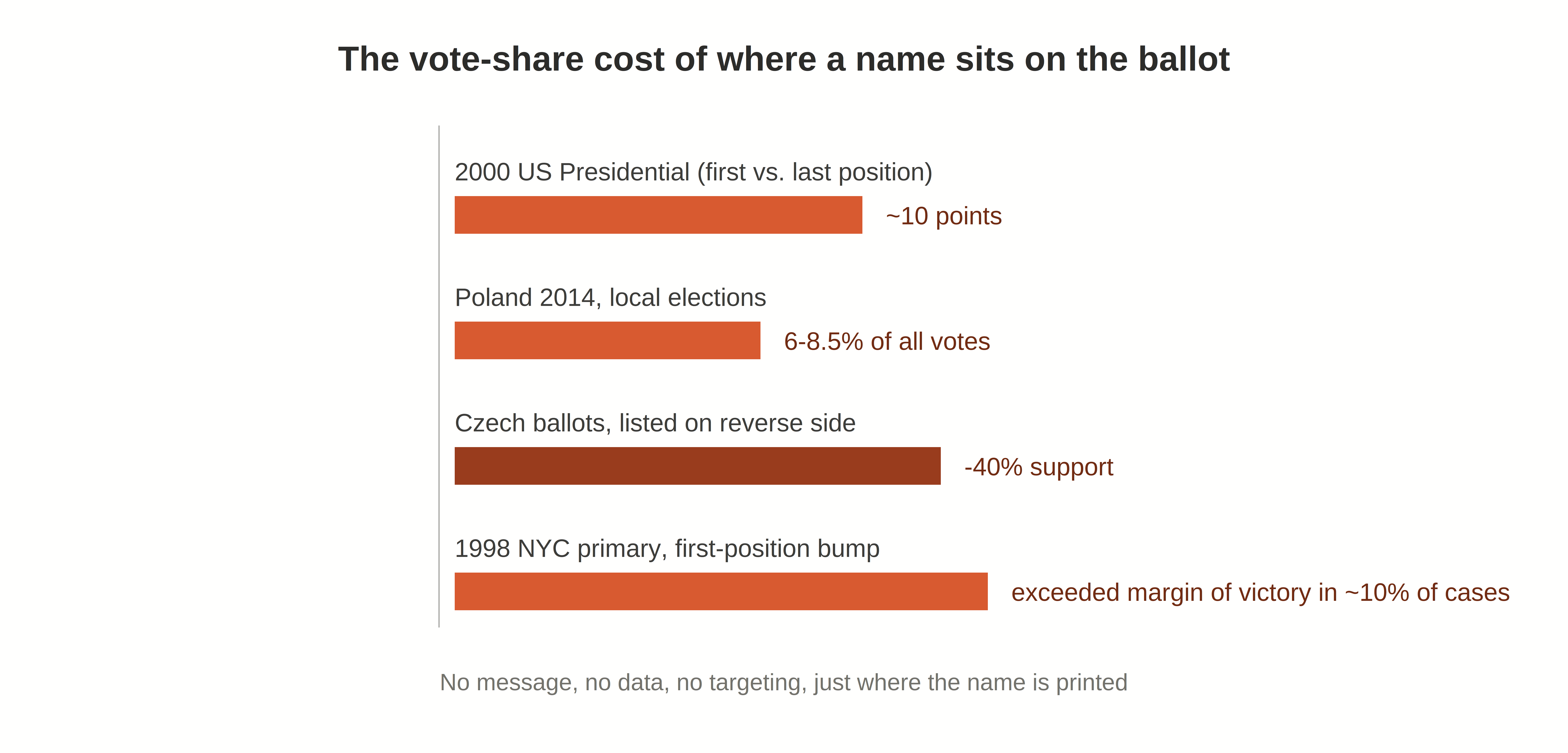
Two honest complications: the effect isn't universal, some ranked-choice studies find none at all, and a 2022 Colombia study found campaigns given a favorable position respond by raising and spending more money, compounding the advantage further.
The Political Business Cycle: When "Normal" Governance Is Actually Election Timing
Nordhaus's 1975 model: incumbents tighten policy early in a term and loosen it right before an election, timed to when voters are paying attention, not when the need is greatest. A 2015 extension replaced steady memory decay with hyperbolic decay, the same hyperbolic discounting this series built out in Article 1, predicting that pre-election spending gets remembered out of proportion to identical spending earlier.
Here's where the theory earns its keep: if a government understood memory decays hyperbolically, would its spending calendar be even, or compressed right before elections? A dedicated study of Indian state elections found exactly that pattern in debt-waiver timing. The theory predicted the shape. The data confirmed it, without anyone ever stating the motive aloud.
Chapter 2Part Two: Eight Global Case Studies
The United States: Two Campaigns, Two Very Different Kinds of "Data-Driven"
Obama 2012 and Cambridge Analytica's 2016/Brexit work get discussed as the same story. They aren't:
- Obama: tactic documented, impact well-supported. A/B testing and database integration measurably improved fundraising and contact efficiency, verifiable without estimating anyone's psychology.
- Cambridge Analytica: harvesting of ~87 million profiles is fully documented, confirmed by Facebook, investigated by UK Parliament, resulting in a $5 billion FTC fine. What's unproven is the company's own central claim, that its models meaningfully changed Brexit or the 2016 election. It folded in 2018. Academic consensus leans skeptical of the efficacy claim specifically, while its ethics violations stay fully intact.
Russia: The Internet Research Agency
- Combined fake domestic-seeming accounts, round-the-clock paid staff, and real-world event organizing, including a "Kids for Trump" gathering and "confederate rallies."
- Facebook: roughly 80,000 organic posts across 120 fake pages, estimated by Facebook to have reached up to 126 million users through shares and likes. Twitter: 2,752 accounts, 1.4 million users notified.
- Total Facebook ad spend, a separate, much smaller channel from the organic posts above: ~$46,000, against $81 million from the two main campaigns combined.
The Senate Intelligence Committee confirmed the operation was extensive and that Trump campaign associates "participated in and enabled" aspects of it, stopping short of a provable conspiracy. Trump's margin in Florida was 1.3 points; combined Michigan/Pennsylvania/Wisconsin, under 78,000 votes. Impossible to rule out a marginal effect. Equally impossible to prove one. Both are true at once.
The Philippines: Rodrigo Duterte's Troll Network, Partially Admitted by Duterte Himself
A rare case with partial confession from the subject himself. Oxford's 2017 study found:
- $200,000 spent, 400-500 staff, overseen by social media manager Nic Gabunada.
- Duterte himself confirmed hiring "online defenders" while calling Oxford "a school for stupid people."
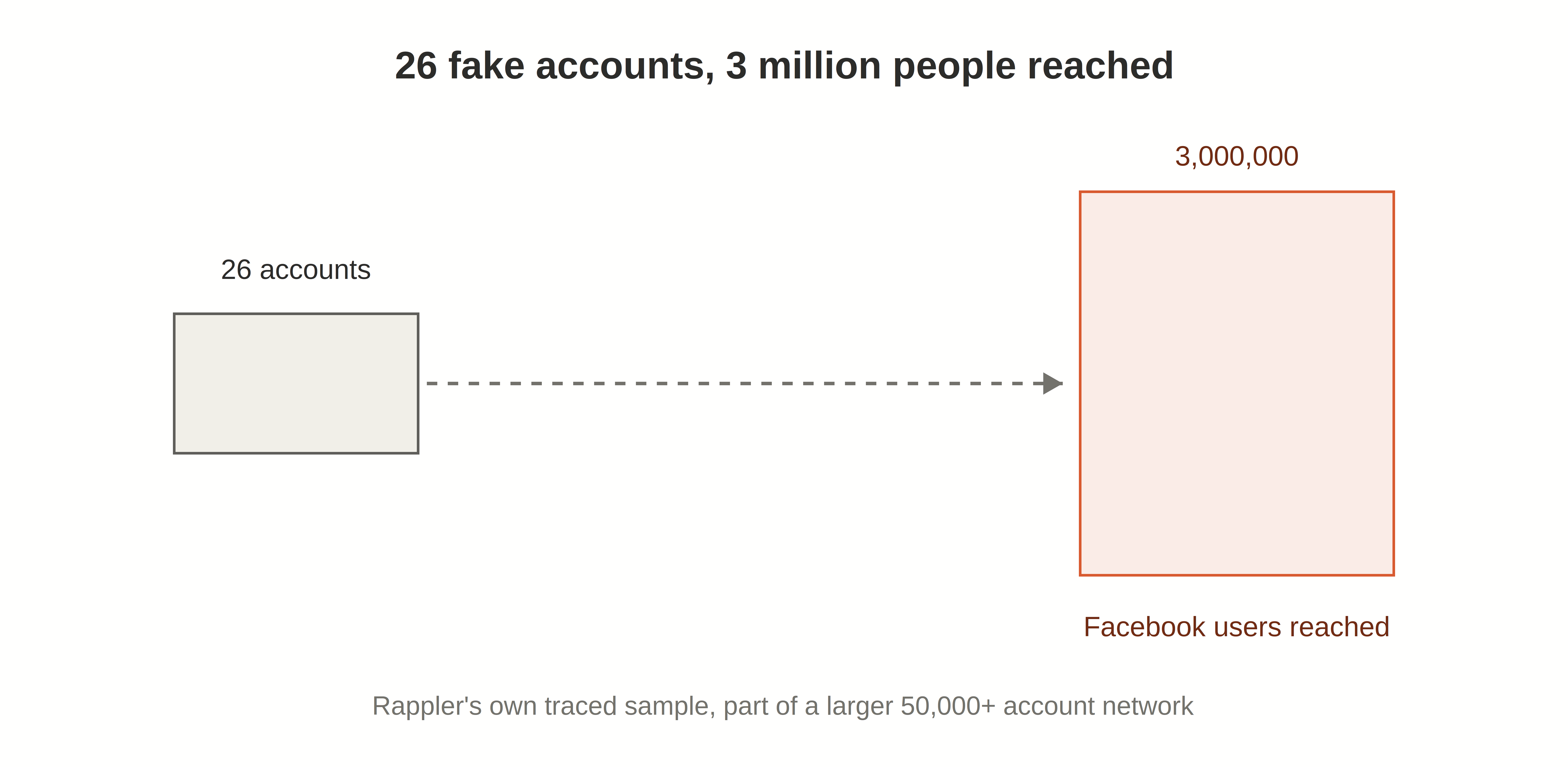
- Rappler traced a 26-account sample network to 3 million users influenced; documented 50,000+ accounts total by November 2016.
- Duterte was involved in 64 percent of all electoral conversation on Facebook by April 2016.
- The infrastructure didn't disband after the election, it turned toward defending the drug war and attacking journalists, Rappler prominent among them.
Brazil: Jair Bolsonaro's WhatsApp Campaign
Closed-group messaging at industrial scale, a mechanism distinct from the open manipulation seen elsewhere:
- Individual businessmen aligned with Bolsonaro each paid an estimated $2.3-3.2 million for bulk WhatsApp services, per Folha de S. Paulo's investigation, using illegally obtained databases, a documented electoral offense on its own regardless of the combined total.
- 56 percent of the most-shared political images were misleading, the large majority favoring Bolsonaro.
- WhatsApp's response: cutting max forwards from 20 to 5.
- The human cost: fact-checker Cristina Tardáguila left Brazil for a period after threats tied to her reporting.
Myanmar: What Happens When the Platform Itself Is Named as a Cause
The UN's 2018 fact-finding mission called Facebook "a useful instrument for those seeking to spread hate" against the Rohingya, in a country where Facebook effectively was the internet. Amnesty International went further, alleging the platform's algorithm "proactively amplified" anti-Rohingya content.
The honest limitation: the UN mission itself said it couldn't fully quantify Facebook's contribution, because Facebook never gave investigators the underlying spread data. More than 700,000 Rohingya fled to Bangladesh; Myanmar's military faces an active genocide case at the ICJ. This is the piece's clearest case where "tactic confirmed, impact proven" and "exact contribution unquantifiable" sit uncomfortably close together.
India: A Cross-Party Arms Race, With a Real Data Problem Underneath It
No single villain here. Both the BJP and Congress run dedicated IT Cells and WhatsApp networks; the BJP alone assigned roughly 900,000 volunteer "pramukhs" for 2019. MIT-led research on 2 million WhatsApp posts found most content across all parties was mundane, not the "cesspool" the popular narrative assumes.
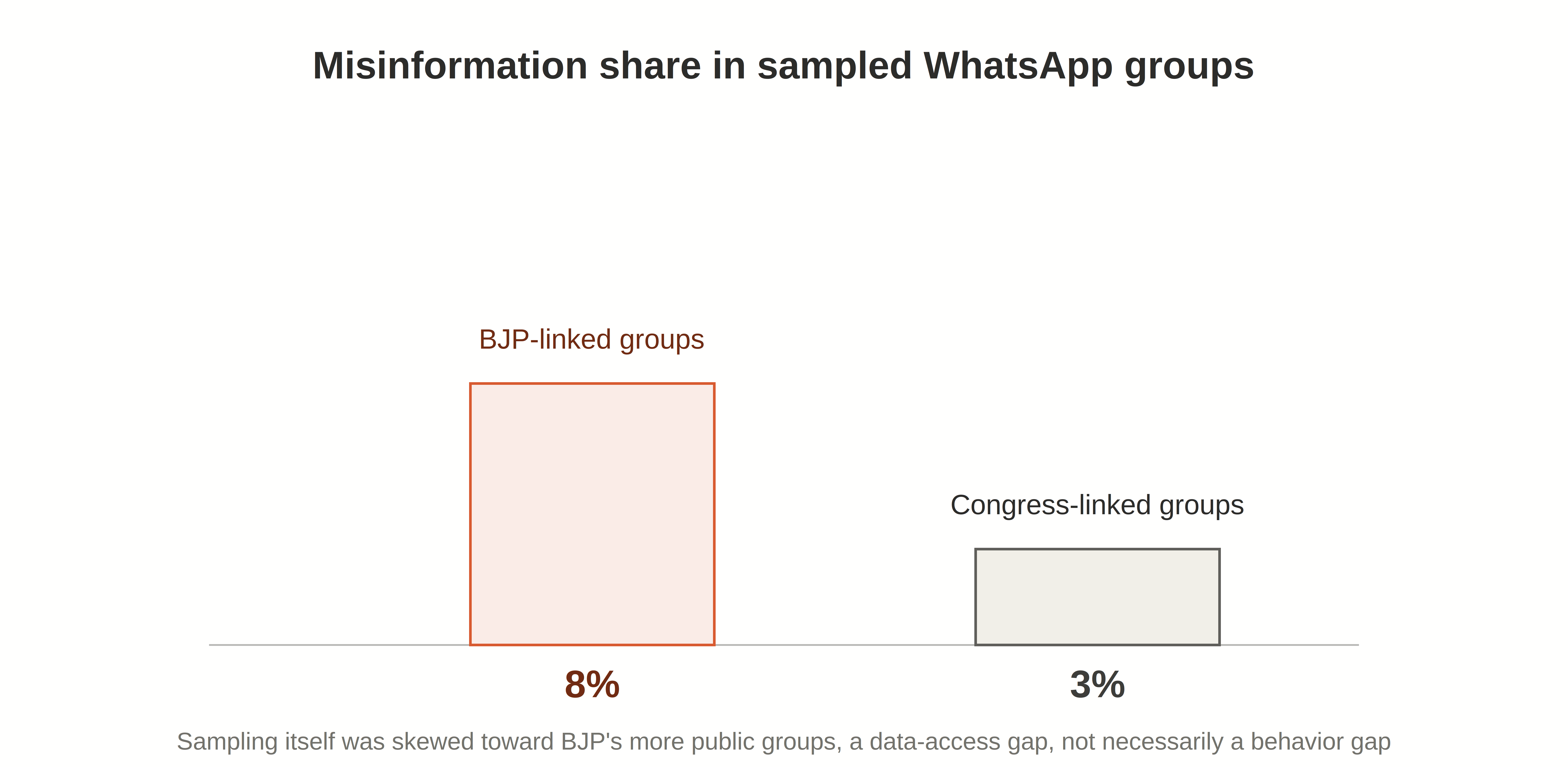
Where a real difference shows up, stated precisely:
- BJP-linked groups: 8 percent misinformation images sampled, versus 3 percent for Congress-linked groups.
- Religious hate-targeting content, aimed at Muslims, concentrated more in BJP-aligned groups, which researchers describe as having pioneered the tactic earlier (~2013) and scaled it further.
- The important caveat: researchers themselves flag that BJP's public groups are simply easier to sample (24 percent of one dataset) than Congress's more closed ones (5 percent), a data-access gap, not necessarily a behavior gap.
The defensible summary: both parties run large, professionalized operations; BJP built earlier and bigger with a documented religious tilt; anything more precise outruns the evidence.
Hungary: When the Case Study Is the Entire Media Market
A government converting the ordinary media market into a standing advantage, independent of any election cycle:
- Fidesz-aligned entities control an estimated 80 percent of Hungary's media market by outlet count, combining the roughly 476 outlets absorbed into the Central European Press and Media Foundation with the separately state-controlled public broadcaster, not one mechanism alone.
- State entities with no ordinary reason to, the central bank, the state energy company, directly financed pro-government campaign ads.
Worth including honestly: the machine has limits. Fidesz's most recent campaign leaned on a claim only 23 percent of Hungarians actually believed, and its margin narrowed considerably against a new opposition challenger. Total media control doesn't guarantee total control of what voters conclude.
Chapter 3Part Three: Freebies and Subsidies as Political Strategy, a Dedicated Global Tour
This earns its own Part because, unlike everything above, it involves no deception at all. Nothing hidden, no data harvested, no fake account. A government simply gives something real, in public, and the psychology still works without concealment.
India: The Most Thoroughly Litigated Version of This Argument Anywhere
- PM Modi called pre-election giveaways "revdi culture" in 2022, warning they're "dangerous for the country's development."
- The Election Commission, having previously refused to regulate this as overreach, reversed itself and now requires financial-feasibility disclosure.
- RBI data: subsidies rose from 7.8 to 8.2 percent of state revenue expenditure (2019-2021); Punjab's debt approached half of state GDP, reported between 46 and 48 percent across 2023-2025 state finance data.
- The Supreme Court itself has flip-flopped: 2013 ruled freebies aren't bribery; 2025 warned free rations risk creating a "class of parasites."
Every major party runs a version of this: AAP built its entire Delhi/Punjab identity on free electricity and water, arguing these are utilities, not freebies. Tamil Nadu's giveaway tradition predates the national debate by a generation, across parties. In Delhi's 2022 election, all three major parties ran competing giveaway lists.
Brazil: A More Complicated Story Than "Cash Buys Votes"
Bolsa Família offers two decades of competing research the Indian debate doesn't have yet:
- Zucco's research across four elections (2002-2014) finds a real, growing incumbent electoral benefit.
- Separate research complicates this directly: cash transfers distributed by transparent rule, shielded from local political brokers, actually reduce old-style clientelism, since a guaranteed benefit makes a poor voter less dependent on a broker's favor.
- A third study finds the legitimacy boost is real but narrow, trust in the incumbent and core institutions specifically, not deeper democratic commitment.
The honest picture: not vote-buying, not pure welfare. The electoral effect and the program's design are inseparable, the same instrument entrenches or weakens patronage depending entirely on whether it's rule-based or discretionary. That distinction applies directly to India's debate too, even though nothing in India's conversation currently draws the line this precisely.
What Ties Both Cases Together
Same machinery this whole series has built: a subsidy becomes a reference point, so its removal triggers loss aversion's steep penalty. Receiving it activates Rabin's reciprocal fairness equilibrium from Article 2, a felt obligation running at electorate scale. Bernie Sanders' 2020 platform faced the identical critique, tens of trillions in estimated cost, same underlying argument, different country, different vocabulary entirely. What varies is only whether the delivery mechanism entrenches dependency or, as Brazil's more transparent designs show is possible, quietly weakens it.
Chapter 4Conclusion
Eight case studies, a complete data pipeline, a dedicated tour of the one tactic that needs no deception, one finding holds throughout: every documented operation is more confirmed as a tactic than proven as a cause. Russia's troll farm cost less than a small business loan and reached 126 million people; whether it changed one vote in a state decided by 1.3 points is honestly unknowable. Cambridge Analytica's harvesting was real; its efficacy claim has been seriously challenged by the same academics who study persuasion. Myanmar's UN investigators named Facebook as an instrument of violence and admitted, in the same report, they couldn't fully quantify its share, because Facebook withheld the data that would have let them.
This isn't a reason to relax. A campaign doesn't need certainty a tactic works to keep using it, only a reasonable belief it might. What this piece actually argues is narrower than either the panic or the dismissal: these tools reliably create real, measurable events, and their downstream effect on any specific voter, in any specific election, remains close to the hardest thing in social science to prove. The tactic gets confirmed. The vote almost never does.
Sources
Mueller, R. S. (2019). Report on the Investigation into Russian Interference in the 2016 Presidential Election. US Department of Justice; US Senate Select Committee on Intelligence (2018-2020). Reports on Russian Active Measures Campaigns; UK House of Commons Digital, Culture, Media and Sport Committee (2019). Disinformation and 'Fake News': Final Report; Kosinski, M., Stillwell, D., & Graepel, T. (2013). "Private Traits and Attributes Are Predictable from Digital Records of Human Behavior." PNAS, 110(15); Simchon, A., et al. (2024). "The Persuasive Effects of Political Microtargeting in the Age of Generative Artificial Intelligence." PNAS Nexus; Coppock, A., et al. (2023). "Quantifying the Potential Persuasive Returns to Political Microtargeting." PNAS, 120(24); Issenberg, S. (2012). "How Obama's Team Used Big Data to Rally Voters." MIT Technology Review; The Markup (2022). "How Political Campaigns Use Your Phone's Location to Target You"; Electronic Frontier Foundation (2024). "How Political Campaigns Use Your Data to Target You"; United Nations Independent International Fact-Finding Mission on Myanmar (2018); Amnesty International (2022). "The Social Atrocity: Meta and the Right to Remedy for the Rohingya"; Bradshaw, S., & Howard, P. N. (2017). "Troops, Trolls and Troublemakers." Oxford Internet Institute; Narayanan, V., et al. (2019). "News and Information over Facebook and WhatsApp during the Indian Election Campaign." Oxford Internet Institute; Garimella, K., & Eckles, D. (2020). "Images and Misinformation in Political Groups: Evidence from WhatsApp in India." Harvard Kennedy School Misinformation Review; Reporters Without Borders (2024-2026). Hungary country reports; Nordhaus, W. (1975). "The Political Business Cycle." Review of Economic Studies, 42(2); Findley, S. (2015). Hyperbolic extension of the political business cycle model; S. Subramaniam Balaji v. State of Tamil Nadu (2013); Reserve Bank of India (2022). State Finances report; Zucco, C. (2015). "The Impacts of Conditional Cash Transfers in Four Presidential Elections (2002-2014)." Brazilian Political Science Review, 9(1); Frey, A. "Cash Transfers, Clientelism, and Political Enfranchisement: Evidence from Brazil." Journal of Public Economics; Layton, M. L., Donaghy, M. M., & Rennó, L. R. (2018). "Does Welfare Provision Promote Democratic State Legitimacy?" Latin American Politics and Society; Lewandowsky, S., Ecker, U. K. H., Seifert, C. M., Schwarz, N., & Cook, J. (2012). "Misinformation and Its Correction." Psychological Science in the Public Interest, 13(3); Johnson, H. M., & Seifert, C. M. (1994). "Sources of the Continued Influence Effect." Journal of Experimental Psychology: Learning, Memory, and Cognition, 20(6); Nyhan, B., & Reifler, J. (2010). "When Corrections Fail: The Persistence of Political Misperceptions." Political Behavior, 32(2); Kahan, D. M. Identity-protective cognition research, various; Johnson, T. J., Bichard, S. L., & Zhang, W. (2009). Selective exposure and political blog readership research