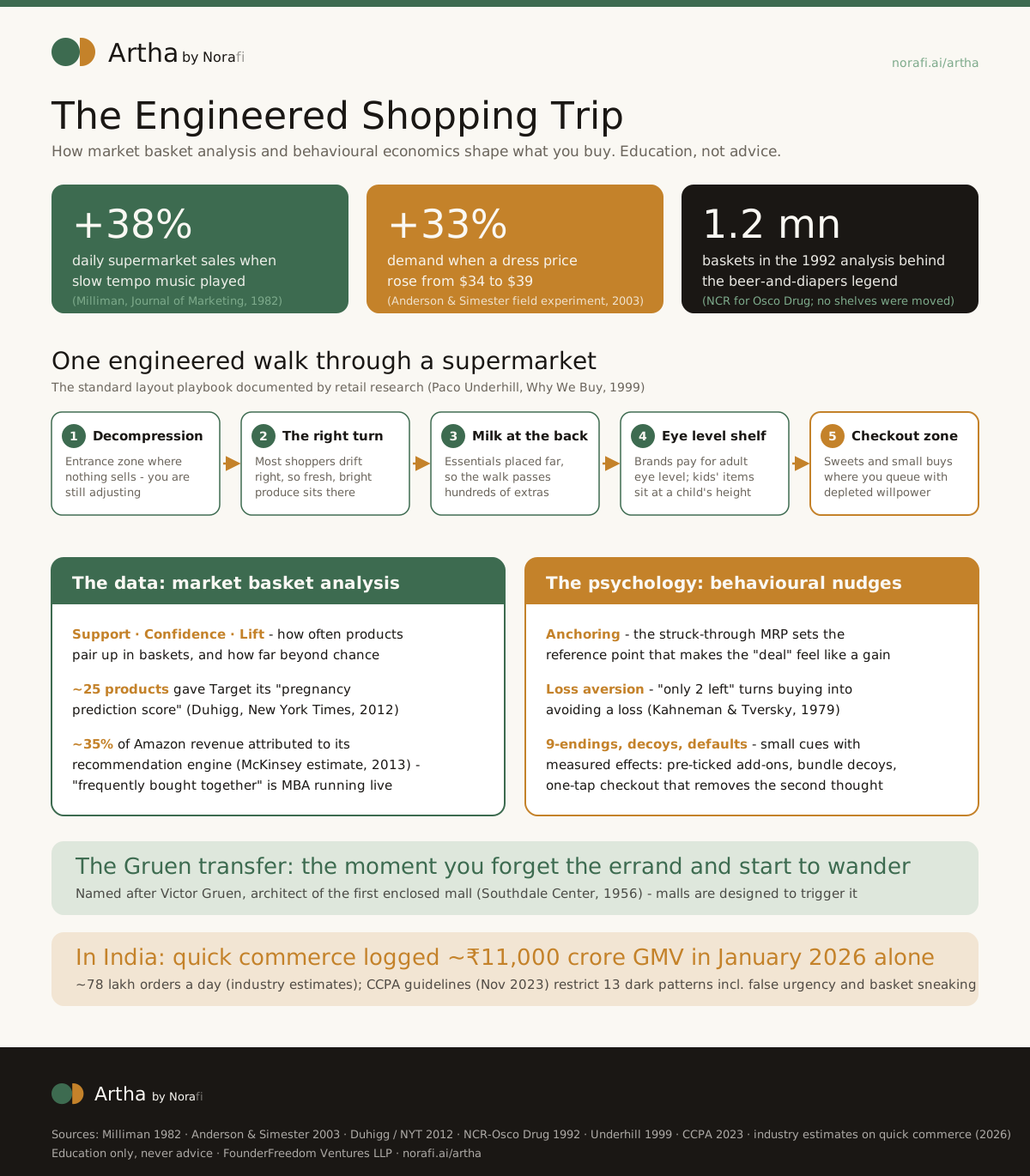
Modern retail runs on two disciplines working together. Market basket analysis is the data science: algorithms scan millions of purchase records to discover which products are bought together, by whom, and when. Behavioural economics is the psychology: it explains the mental shortcuts - anchoring, loss aversion, scarcity, defaults - that make shoppers respond predictably to prices, layouts, and prompts. A supermarket aisle, a mall atrium, and a quick commerce app are all built on this pairing: the data finds the pattern, and the psychology turns the pattern into a sale. None of this is illegal or even hidden; it is simply engineering applied to human attention, and knowing how it works is the best defence a shopper has.
What is market basket analysis?
Market basket analysis (MBA) is a data mining technique that finds association rules in transaction data - statements like "shoppers who buy X also tend to buy Y." The method was formalised in 1993, when researchers at IBM (Agrawal, Imielinski, and Swami) published the association rules framework, followed by the Apriori algorithm in 1994, which made it practical to mine huge retail datasets.
Three numbers describe every rule. Support measures how often a combination appears in all baskets. Confidence measures how often Y appears given that X was bought. Lift measures how much more likely the pair is than chance: a lift of 3 means the combination occurs three times more often than if the two products were unrelated. (These are definitions, not real store data - any specific figures a retailer uses are proprietary.)
Retailers act on these rules in visible ways: which products share an aisle or an end-cap display, which items get bundled into combo offers, what "frequently bought together" shows you online, and which coupon is printed on the back of your bill.
Chapter 2Did the famous beer and diapers story really happen?
Partly - the correlation was real, but the legend built on it is not. In 1992, an NCR (later Teradata) team led by Thomas Blischok analysed 1.2 million baskets from 25 Osco Drug stores and found that beer and diapers were bought together, mostly between 5 pm and 7 pm. The popular version of the story says the store moved beer next to diapers and sales of both soared. That never happened. Osco used the analysis for something less cinematic: pruning around 5,000 slow-moving products, which shoppers experienced as a better range.
The story matters because it is the founding myth of retail analytics, and its embellishment is itself a lesson: correlations are easy to find, but a correlation is not an explanation, and not every pattern is worth acting on.
Chapter 3What is behavioural economics, and which biases do retailers use?
Behavioural economics, built on the work of Daniel Kahneman and Amos Tversky, studies how real decisions deviate from rational calculation in predictable ways. Retail applies a short list of its findings over and over:
- Anchoring: the first price you see sets the reference. An "MRP Rs 4,999, now Rs 2,499" tag makes Rs 2,499 feel like a gain, regardless of the product's actual worth.
- Loss aversion: losses hurt roughly twice as much as equivalent gains feel good (prospect theory, 1979). "Only 2 left" and "sale ends tonight" convert buying into avoiding a loss.
- Charm pricing: in a field experiment by Anderson and Simester published in 2003, raising a dress's catalogue price from 34 to 39 dollars increased demand by about a third, while raising it to 44 dollars changed nothing. The 9-ending itself did the work.
- The decoy effect: adding a deliberately unattractive third option shifts choices toward the target option, a pattern Dan Ariely demonstrated with The Economist's subscription pricing in Predictably Irrational (2008).
- Defaults and friction: pre-ticked add-ons ride on inertia, and one-tap checkout removes the pause in which second thoughts happen.
How is a physical store laid out to make you spend more?
Almost nothing about a supermarket's geography is accidental. Retail researcher Paco Underhill, whose firm Envirosell filmed thousands of shopping trips for the book Why We Buy (1999), documented the standard playbook: a "decompression zone" at the entrance where nothing sells (shoppers are still adjusting), a bias to turn right on entering, and wider aisles because shoppers abandon products when brushed from behind - the "butt-brush effect."
The rest of the layout applies the same logic. Milk, eggs, and other essentials sit at the back, so reaching them walks you past hundreds of discretionary products. Brands often pay for placement at adult eye level - "eye level is buy level" - while items aimed at children sit lower, at a child's eye level. The checkout queue is lined with chocolates and batteries: low-cost impulse items placed where you are captive and your willpower is depleted.
Even the soundtrack is calibrated. In Ronald Milliman's 1982 experiment published in the Journal of Marketing, a supermarket that played slow-tempo music (under 72 beats per minute) saw shoppers move more slowly and daily sales rise about 38 percent compared with fast-tempo days.
Chapter 5Why do malls feel disorienting on purpose?
The modern enclosed mall descends from Southdale Center (Minnesota, 1956), designed by architect Victor Gruen, and the industry named an effect after him. The "Gruen transfer" is the moment a purposeful shopper, hit by an intentionally stimulating and mildly confusing environment, forgets the errand and starts wandering - the point at which browsing becomes buying. Few clocks, limited sightlines to exits, anchor stores placed at opposite ends so foot traffic crosses everything in between: the architecture is an impulse-purchase machine. Gruen himself later disowned what malls became.
Chapter 6Case study: how did Target predict a shopper's pregnancy?
The best documented case of basket data becoming behaviour prediction is Target (the US retailer), reported by Charles Duhigg in The New York Times in 2012. Statistician Andrew Pole cross-referenced purchase histories with the baby registry and found that about 25 products - unscented lotion, supplement purchases, large cotton-ball packs - together produced a "pregnancy prediction score," accurate enough to estimate a due date. The story became famous when a father complained about baby-product coupons mailed to his teenage daughter, then discovered she was in fact pregnant.
The quieter detail is more instructive: shoppers found accurate targeting creepy, so Target began mixing baby offers among unrelated items like lawnmowers so the personalisation would not show. The analytics did not get less powerful; the presentation got more deliberate.
Chapter 7Case study: why was Big Bazaar deliberately crowded?
Kishore Biyani built Big Bazaar, once India's largest hypermarket chain, on a behavioural insight that ran opposite to Western retail wisdom. Early, neat, Western-style layouts intimidated the mass Indian shopper; orderly and quiet read as expensive. So Biyani re-engineered stores to feel like a bazaar - narrower, busier, heaped displays, staff in everyday clothes - because for his customers, hustle and clutter signalled low prices and permission to touch, bargain-hunt, and belong. He described the philosophy in his book It Happened in India (2007).
The lesson is that atmospherics are coded messages, and the code is cultural. A minimalist store and a crowded one can both be precision instruments aimed at different audiences. (Big Bazaar's later collapse was a story of debt and expansion, not of this insight failing.)
Chapter 8How do apps and quick commerce use the same playbook?
Online, the machinery is faster and more personal. A widely cited McKinsey estimate from 2013 put around 35 percent of Amazon's revenue down to its recommendation engine - market basket analysis running live, per user. Free-delivery thresholds ("add Rs 87 more") are basket-building nudges; countdown timers and "only 1 left" tags manufacture urgency; ten-minute delivery removes the cooling-off period between wanting and having.
How can a shopper recognise the machinery?
Awareness converts most of these nudges from invisible to merely annoying. A shopping list made before entering the store is a pre-commitment device that counters layout tricks. Reading unit prices (per kg, per litre) on the shelf tag defeats pack-size and charm-pricing games. Treating "limited stock" claims as marketing copy until proven otherwise blunts scarcity. Deleting saved card details adds back the friction that one-tap checkout removed. And noticing the Gruen moment - "why am I in this aisle?" - is usually enough to end it. Related reading: the guides on why we overspend and common money biases.
How Nora helps
Nora can act as the counterweight to this machinery. Before a big purchase, you can ask Nora to break down a "deal" - what the anchor price is doing, what the effective unit price is, whether a bundle actually saves money - and to check a purchase against your own budget instead of the retailer's script. Understanding the nudge in the moment is what turns an engineered impulse back into a choice.
App · coming soonWhat this means for you
Retail environments are not neutral; they are optimised systems built from your own aggregated behaviour. That is not a reason for paranoia - the same data science also shortens queues and keeps shelves stocked - but it is a reason to treat store layouts, prices ending in 9, urgency banners, and "people also bought" prompts as designed inputs rather than background noise. The shopper who can name the technique is the one it works least well on.