A man in the first article of this series lost a bonus he never actually had, and the loss felt real anyway. A stock in the third article traded more shares in a single day than technically existed. Somewhere between those two facts sits the actual argument this series has been making for four articles: that the human mind doesn't evaluate what's true, it evaluates what's expected, and almost nobody outside a university ever needed the formal proof to start using that fact on purpose.
This article goes looking for where they used it. Not in a lab, not in a paper, but in an elevator lobby, a urinal, a wine list, a credit card statement, a hospital's default paperwork. Thirteen industries, twenty-two named cases, and one running question underneath all of it: of the nineteen formal models the first three articles built, piece by piece, which ones does each of these actually run on, and which ones don't fit at all, no matter how hard the comparison is pushed.
For the first half-century of its existence, behavioral economics stayed inside the university. Nobel laureates, laboratory experiments, dense proofs, all converging on the same finding: Homo economicus, the rational calculator classical economics assumes, doesn't exist. Real people are reference-dependent, loss-averse, and swayed by framing in ways precise enough to formalize, which this series has now done nineteen separate times. Then the people actually running trains, hotels, and tax offices got hold of the same research, frequently decades before it had an academic name at all, and simply started using it.
Chapter 1The Psychology of Perception: Why Fix the Feeling, Not the Problem?
The Alchemist and the Six-Billion-Pound Non-Solution. Rory Sutherland, vice chairman of Ogilvy UK, has built a career on one pointed critique of corporate problem-solving: organizations reach for an engineering fix when the actual problem was never engineering at all. His most cited parable involves the Eurostar. In the early 2000s, the British and French governments spent roughly £6 billion shortening the London-to-Paris rail journey by about 40 minutes. Sutherland's counterproposal, offered as illustration rather than a real bid, was blunter: for a fraction of that cost, hire supermodels to walk the aisles pouring free champagne. The travel time stays identical. Passengers stop wanting the journey to end sooner.
This is Salience Theory, Bordalo, Gennaioli, and Shleifer's model from this series' first article, doing the work before it had that name. The engineering fix targeted the number on a spreadsheet. The champagne would have targeted what was actually salient to a bored passenger, which was never the travel time at all.
Mature Cheddar. Sutherland has told a related story about Walkers Crisps, where a cheese-flavored crisp needed a sales lift. The logical move was reformulating the flavoring. Instead, his agency renamed the flavor from "Cheese" to "Mature Cheddar," changing nothing about the product. Worth flagging honestly: this is Sutherland's own frequently repeated anecdote rather than an independently documented case with published sales figures, "Mature Cheddar" is a genuine Walkers product name, but I could not find independent confirmation of the rename-and-sales-lift narrative itself. The underlying mechanism, a label shifting which attribute of an unchanged product becomes the one a shopper's attention lands on, is still Salience Theory doing real work, whatever the exact provenance of this specific telling.
The Million-Dollar Elevator and the Five-Dollar Mirror. The same logic, applied to physical space instead of language, produced one of environmental psychology's most cited stories, referenced widely by researchers including Don Norman. A mid-century Manhattan office building faced serious tenant complaints about slow elevators, with lease cancellations on the table. The engineering fix, new motors and rewired shafts, would have cost millions. A behavioral consultant's fix cost under a hundred dollars: full-length mirrors in the elevator lobbies. Complaints dropped to zero. The elevators never got faster. Worth the same honesty applied above: this parable is widely repeated across behavioral design writing, but a single verifiable original source, the specific building, the specific consultant, proved elusive to pin down independently, closer in evidentiary standing to a well-worn industry story than a documented case study.
David Maister's 1985 analysis of waiting-line psychology formalized why the mechanism itself should work, regardless of this particular telling's provenance: unoccupied time feels categorically longer than occupied time. The mirror is Salience Theory doing the same job as the champagne and the cheese, handing a waiting passenger's attention something other than the floor indicator to land on.
The Eighty-Percent Solution, Etched in Porcelain. Amsterdam's Schiphol Airport solved a cruder version of the same problem in the men's restrooms, where poor aim was driving up cleaning costs. Aad Kieboom, the airport manager credited with the fix, etched a small, realistic housefly into each urinal, just above the drain. Kieboom has reported an 80 percent reduction in spillage, worth stating plainly as his own operational estimate rather than a peer-reviewed finding, one investigation into the claim found no formal study was ever conducted, and Kieboom himself has described the number as "very empirical." The mechanism holds regardless: the same salience-in-physical-space effect as the elevator mirror, a target that captures attention before deliberation gets a turn.
Chapter 2Anchors, Decoys, and the Reference Point That Isn't Really There
The Eye Patch and the Man Nobody Could Stop Wondering About. David Ogilvy was applying behavioral insight to advertising decades before most of it had academic names. In 1951, tasked with selling Hathaway shirts against entrenched competitors like Arrow, Ogilvy photographed a distinguished model wearing one, and added an eye patch. The patch did nothing for the shirt's fit, durability, or price. It made the ad impossible to scroll past, generating an unanswered narrative question, who is this man, that Byron Sharp's 2010 concept of mental availability would later formalize: consumers buy disproportionately from whatever comes to mind fastest at the moment of purchase. This, too, is Salience Theory, distinctiveness manufacturing attention-grabbing contrast, aimed at a photograph instead of a price tag.
The Decoy in the Room. Dan Ariely's decoy-effect research applied the identical insight to pricing architecture. The Economist's subscription page once offered digital-only at $59 and print-only at $125, an option so dominated by digital that almost nobody chose it. Adding a third option, print-and-digital, also at $125, didn't make the print-only tier useful. It made the bundle look like a steal by comparison, and most subscribers shifted to it.
The Anchored Bread Maker. Williams-Sonoma ran the same play physically: when a $279 bread maker sold poorly, the fix wasn't a price cut, it was introducing a $429 model nobody was expected to actually buy. Beside it, the $279 unit read as the sensible compromise, and sales roughly doubled. Both cases are Salience Theory once more, now doing pricing work: a product's perceived value isn't computed in isolation, it's read off whatever else happens to be sitting in the same comparison.
The Anchoring Illusion of the Air Show. Reference dependence gets a more literal illustration in Rolls-Royce's decision to stop exhibiting at motor shows. Parked next to a £50,000 Mercedes, a £300,000 Rolls-Royce reads as an extravagance. Parked at an aviation show next to a £50 million private jet, the identical car reads as a remarkably sensible ground-transportation accessory for someone who just bought the jet. Nothing about the car changed, only the reference class it was judged against, close to a direct staging of Kőszegi and Rabin's argument from this series' first article: a reference point isn't a fixed anchor, it's constructed by whatever comparison set the buyer's expectations are being drawn from in that moment.
Chapter 3Effort, Ownership, and What a Sunk Cost Actually Buys a Business
Monetizing the Allen Wrench. IKEA's flat-pack assembly began as a logistics fix, Ingvar Kamprad needed furniture that fit in a car, but it became a demonstrated psychological asset. Customers who assemble their own furniture consistently value it more than an identical, pre-assembled piece, a finding Norton, Mochon, and Ariely formalized directly in their 2012 Journal of Consumer Psychology paper across four separate studies, including IKEA boxes, origami, and Lego builds.
The usual explanation stops at effort justification: labor invested resolves into inflated value. There's a sharper way to see it through this series' own vocabulary. Assembling the piece sets an expectation of what the finished product should be worth, given the hours just spent on it, and that expectation becomes the reference point the final valuation gets judged against, Kőszegi and Rabin's mechanism again, formed through labor instead of a purchase price.
Gamifying Loyalty. Hotel and airline loyalty programs monetize a related instinct at a longer horizon. Joseph Nunes and Xavier Drèze's 2006 car-wash experiment is the clean version: 300 customers received one of two loyalty cards, one requiring eight stamps from zero, another requiring ten stamps but arriving with two already filled in. Both groups needed exactly eight more washes.
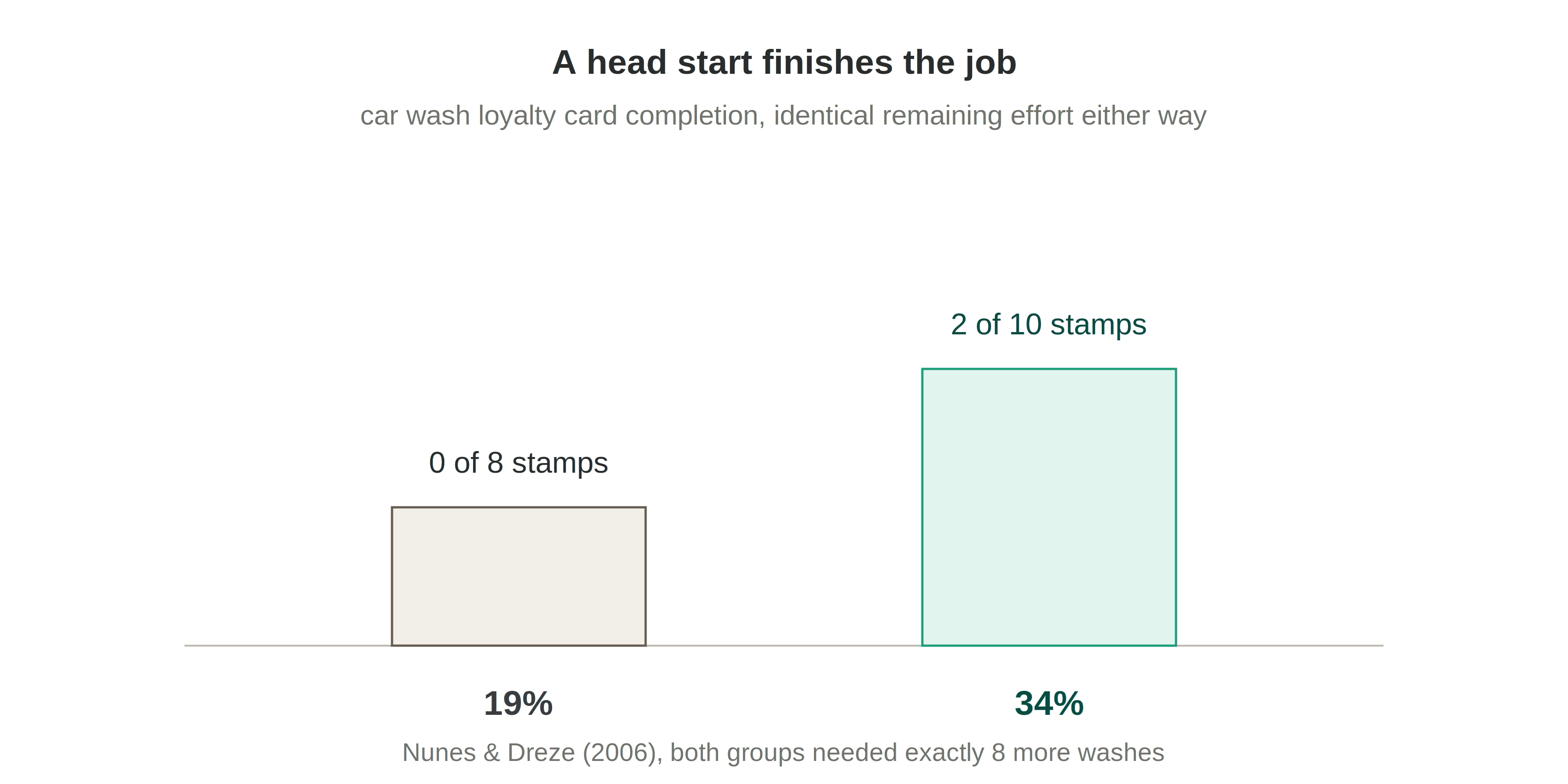
The pre-stamped group finished at 34 percent completion against 19 percent for the blank-card group, nearly double, for identical remaining effort. Marriott and Hilton's progress bars ("four nights from Platinum") run this mechanic continuously. And once status becomes something a member feels they own, the connection sharpens further than "endowment effect" alone captures: the expected tier itself becomes the reference point, the same Kőszegi-Rabin mechanism running a third time in this piece, which is exactly why switching to a cheaper competitor registers as a loss of status, not merely a missed discount, and why the psychological cost of leaving so often outweighs the real financial saving on the table.
The Streak and the Endowment of Digital Fire. Duolingo's Streak feature runs the identical compounding on a daily cycle. A counter that starts as a simple record becomes, by day fifty, an asset the user feels they own, and missing a day stops being a pause in learning and becomes destruction of that asset.
The pain of breaking a hundred-day streak is large enough that users complete lessons they no longer care about purely to preserve the number, and Duolingo monetizes the mechanism directly by selling "Streak Freezes," insurance against a user's own future lapse. This is loss aversion in its purest form, the same asymmetric weighting this series traced back to prospect theory's own value function in the third article, now operating on a digital counter instead of a stock position.
Chapter 4Making Money Invisible, or Making Its Absence Impossible to Ignore
The Invisible Investor. Micro-investing app Acorns solved a different problem: getting people to start investing at all. The barrier wasn't fees or literacy, it was what Prelec and Loewenstein's 1998 framework calls the pain of paying, the immediate sting of watching money leave an account. Acorns' round-up feature avoids it entirely: a $3.50 coffee gets charged at $4.00, with the fifty cents invested automatically, never mentally filed as "investment capital," just "spare change," Richard Thaler's mental accounting doing exactly the work it was formalized to describe.
The Frictionless Fantasy of the Magic Band. Disney's MagicBand applies the same friction-removal logic to an entire theme park, a wristband tap replacing the wallet reach that would normally trigger a moment of hesitation. Disney's own reported figures from the MyMagic+ rollout showed per-capita guest spending up roughly 4 percent and per-room hotel spending up roughly 3 percent within six months of launch, a real, if more modest than sometimes claimed, confirmation of the effect.
Both Acorns and the MagicBand are worth reading through Gul and Pesendorfer's model from this series' first article, run in reverse. That model showed a tempting option sitting on a menu imposes a resistance cost even when never chosen. Acorns and the MagicBand engineer away the moment where any resistance, to spending, to saving, would normally get evaluated at all, one pointed at saving, one at spending, the identical mechanic aimed in opposite directions.
Restaurant menus that drop the currency symbol, printing "14" instead of "$14.00," belong in this exact company: the dollar sign is a small, recurring reminder that money is leaving the diner's hand, and removing it is a third instance of the same trick, deleting the resistance-evaluation moment rather than making the resistance easier to win.
The Minimum Payment Trap. Credit card statements run a related psychology toward the issuer's benefit instead of the consumer's. Neil Stewart's 2009 study, already covered in this series' first article for a different reason, found that a printed minimum-payment figure anchors repayment downward, cardholders shown one paid roughly 70 percent less toward their balance than cardholders who weren't.
The fuller connection is worth making explicit: this isn't only the anchoring effect that article named it as. A naive, present-biased cardholder, the exact type O'Donoghue and Rabin's model formalized, believes they'll pay off the balance soon regardless, which is precisely what removes any internal resistance to anchoring on the minimum in the first place. The bias and the blind spot reinforce each other, in a loyalty program, an investing app, and a credit card statement alike, the same handful of mechanisms, wearing different industries.
Chapter 5Menus, Wine Lists, and the Psychology of a Second-Cheapest Bottle
The $150 Bottle Nobody Orders. Wine lists routinely carry at least one bottle priced well above everything else on the page, not because restaurants expect it to sell, but because its presence resets what counts as reasonable for everything beneath it. A $120 bottle reads as moderate next to a $900 one and extravagant next to a $40 one, with nothing about the $120 bottle itself having changed, the same Salience Theory doing the same anchoring work as the Williams-Sonoma bread maker, just poured instead of baked.
Industry pricing analyses have also repeatedly noted a related pattern, sometimes called the second-cheapest-bottle effect: diners avoid the single cheapest wine to avoid looking as though they're economizing, gravitating instead to the next tier up, which restaurants can price with a healthier margin than the true bottom of the list. Worth flagging honestly: that second pattern is well-documented industry lore rather than a single controlled study, closer in evidentiary weight to Kieboom's urinal estimate than to a peer-reviewed finding.
The Illusion of the Middle Beer. Beer menus run the same extremeness-aversion logic more explicitly. Faced with $5, $7, and $9 options, most drinkers gravitate to $7, avoiding both the status cost of the cheapest choice and the discomfort of the most expensive. Remove the $5 option, and $7 becomes the new floor, pushing a meaningful share of drinkers up to $9 rather than accept feeling like they chose the bottom rung.
That "status cost" is worth taking literally rather than as a figure of speech: choosing the cheapest drink on a menu isn't just financial, it's a felt departure from how the diner wants to be seen at that table, Akerlof and Kranton's Identity Economics from this series' second article, operating in a genuinely unexpected place.
Chapter 6Manufacturing Demand, and Watching a Manufactured Signal Fail
The Diamond Illusion. Before the 1930s, diamond engagement rings weren't a cultural default. De Beers, sitting on unsold inventory as Depression-era demand collapsed, hired the N.W. Ayer agency to manufacture one. Copywriter Frances Gerety's 1947 line, "A diamond is forever," embedded the stone into the social contract of marriage, while De Beers simultaneously normalized spending two, later three, months' salary on the ring.
The standard account stops at signaling theory: a credible signal must be costly to fake, and an artificially scarce, high-priced stone fit that requirement perfectly. But the campaign manufactured more than a costly signal, it manufactured a prescribed identity. What a devoted fiancé does is spend a specific multiple of his salary on a ring; falling short isn't just a smaller gift, it reads as a smaller commitment. That is Akerlof and Kranton's exact structure a second time in this piece, a category, a behavior prescribed for anyone in it, a felt cost for falling short, not a missed signal but a failure of identity.
It worked for eighty years. It is now visibly failing: lab-grown diamonds are a physically identical substitute at a fraction of the cost, and once a credible substitute exists, the signal stops being costly to fake, which is exactly the condition under which both the signaling mechanism and the identity prescription should be expected to weaken together. Worth noting honestly: the specific internal decision-making inside the 1930s-40s campaign is less independently documented than the paper citations elsewhere in this piece, the broad narrative is well corroborated across historical accounts, but I can't point to a single peer-reviewed source confirming every detail.
The Digital Panopticon. Booking.com's checkout screens ("Only 1 room left!", "3 people looking right now") are a faster-cycle version of manufactured scarcity, leaning directly on loss aversion, weighting the fear of losing a deal roughly twice as heavily as the pleasure of securing one. It's also close kin to Regret Theory from this series' first article: the message isn't selling the room, it's selling the anticipated regret of discovering tomorrow that the room sold out. It shows the identical failure pattern as the diamond signal, for the identical reason. A shopper who sees "only 1 left" on a hotel chain with hundreds of rooms now correctly infers dynamic-pricing theater rather than genuine scarcity, and the signal degrades exactly as it becomes ubiquitous.
Chapter 7The Limits of Choice, and What Happens When a Retailer Ignores Them
The Paradox of Choice and the Treasure Hunt. Trader Joe's built a real advantage on Barry Schwartz's finding that decision quality and purchase likelihood both fall once the number of options crosses a threshold, even though classical theory says more choice should only ever help. Where a standard supermarket stocks 30,000 to 40,000 SKUs, Trader Joe's caps inventory near 4,000.
The usual explanation is cognitive load alone. There's a sharper reading through this series' own vocabulary: a shopper facing thousands of near-substitutable products isn't reasoning less, they're reasoning noisier, precisely McKelvey and Palfrey's Quantal Response Equilibrium from this series' second article, decision quality degrading as the choice set's complexity rises, not because shoppers stop trying to pick well, but because picking well gets statistically harder the more comparably good options sit on the shelf. A smaller choice set is a direct lever on that noise, not just a mood-lightening design choice.
The Billion-Dollar Mistake of Fair Pricing. J.C. Penney's 2012 pricing overhaul is the clearest demonstration in this piece of what happens when a company assumes the theory doesn't apply. New CEO Ron Johnson replaced the store's chaotic mix of markups and perpetual "sales" with flat, transparent, everyday prices, removing what he correctly identified as a logically incoherent pricing maze. Sales fell 25 percent within a year, the stock halved, and Johnson was fired.
The standard explanation cites Thaler's distinction between acquisition utility and transaction utility, the separate pleasure of feeling like the price was beaten. There's a more precise way to say what actually broke, using this series' own machinery: the old crossed-out $40 price was never just marketing copy, it was the expectation a shopper walked in holding, Kőszegi and Rabin's reference point a third time in this piece, and the $20 "sale" price only registered as a gain because it sat below that expectation. Remove the $40, and there's nothing left for $20 to beat. The item didn't get more expensive. It simply stopped having anything to feel good about.
The Shrinkflation Illusion. Shrinkflation exploits a narrower, more mechanical limit: the Weber-Fechner law, which holds that the just-noticeable difference between two stimuli scales with the size of the original stimulus. A ten percent price increase is immediately, numerically obvious. A ten percent reduction in a chocolate bar's weight is close to invisible to touch and sight.
The psychophysics explains how the trick works. It doesn't explain why brands bother playing it instead of simply raising the price outright, and that half of the question is the same loss aversion this entire series has been built on since its first article: a visible price increase registers as a loss the instant it's seen, while an invisible weight reduction never triggers that reaction at all, right up until the shrinkage crosses into functional inadequacy, a toilet roll too small to use, a chip bag mostly air, at which point consumer anger shifts from the price to the product itself.
Chapter 8Beyond the Marketplace: When Government Reads the Same Research
The Nine-out-of-Ten Letter. Every case study so far involves a business extracting revenue, retention, or margin from a bias this series spent three articles formalizing. Two examples close this piece with something different, no product changed hands in either, and one of them isn't selling anything at all.
The UK's Behavioural Insights Team, universally known as the Nudge Unit, tested a small change to overdue tax reminder letters starting in 2011. Standard letters were rewritten to include one social-norm sentence: "nine out of ten people in the UK pay their tax on time. You are currently in the very small minority of people who have not paid us yet."
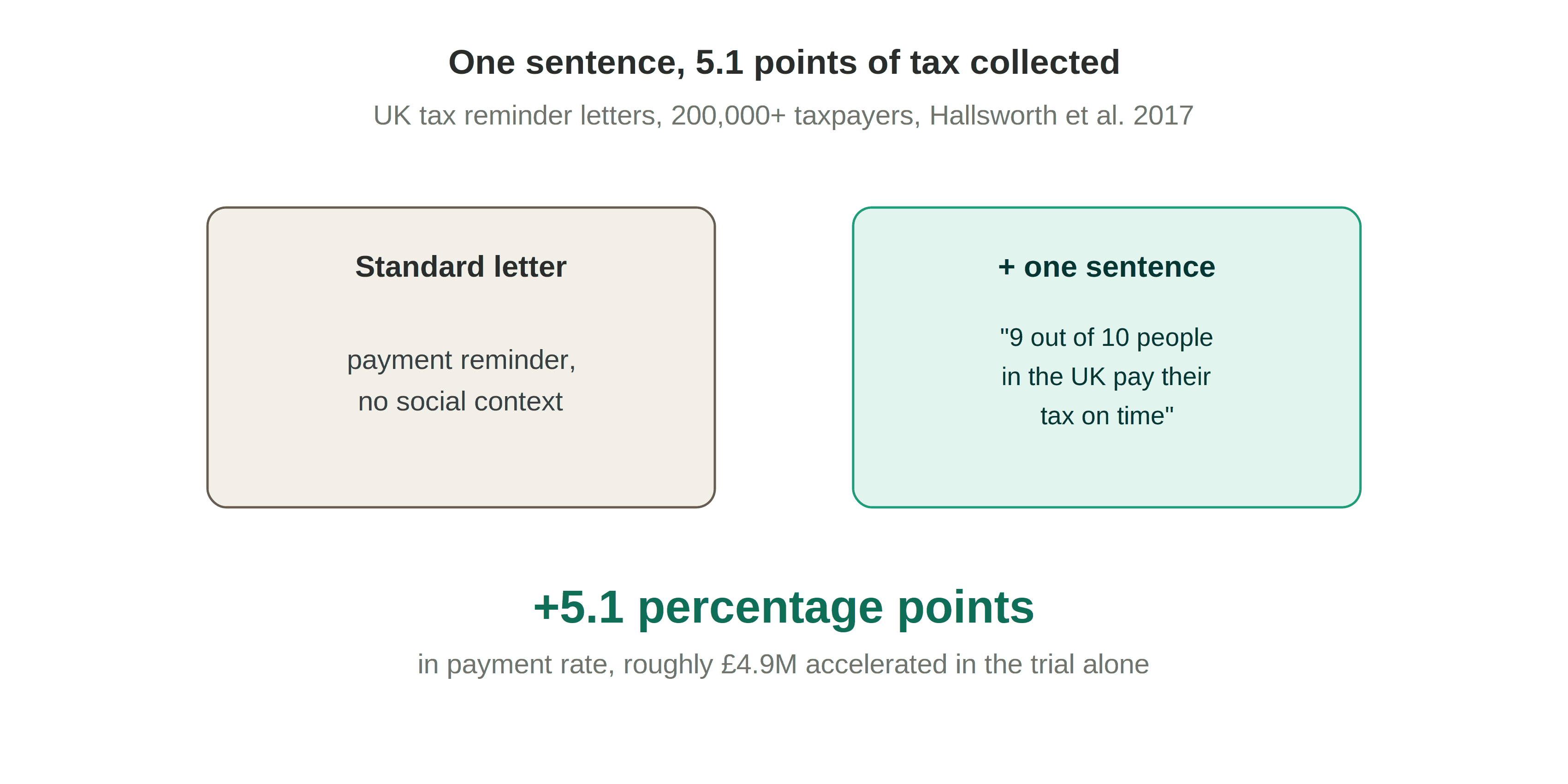
Applied across a natural field experiment covering more than 200,000 taxpayers with outstanding balances, the norm-based letters raised payment rates by up to 5.1 percentage points over standard letters, accelerating an estimated £4.9 million in collections during the trial alone, published by Hallsworth, List, Metcalfe, and Vlaev. The mechanism sits close to, without being identical to, the informational cascade logic this series formalized in its third article: rather than each taxpayer weighing a purely private cost-benefit calculation, the letter directly supplies a piece of social information, what everyone else in your position already did, and lets that observation do work an appeal to self-interest alone couldn't.
The One That Doesn't Sell Anything. Eric Johnson and Daniel Goldstein's 2003 paper in Science, "Do Defaults Save Lives?", is the closer, and it's the cleanest demonstration in this entire piece that these mechanisms were never actually about commerce, commerce just found them first.
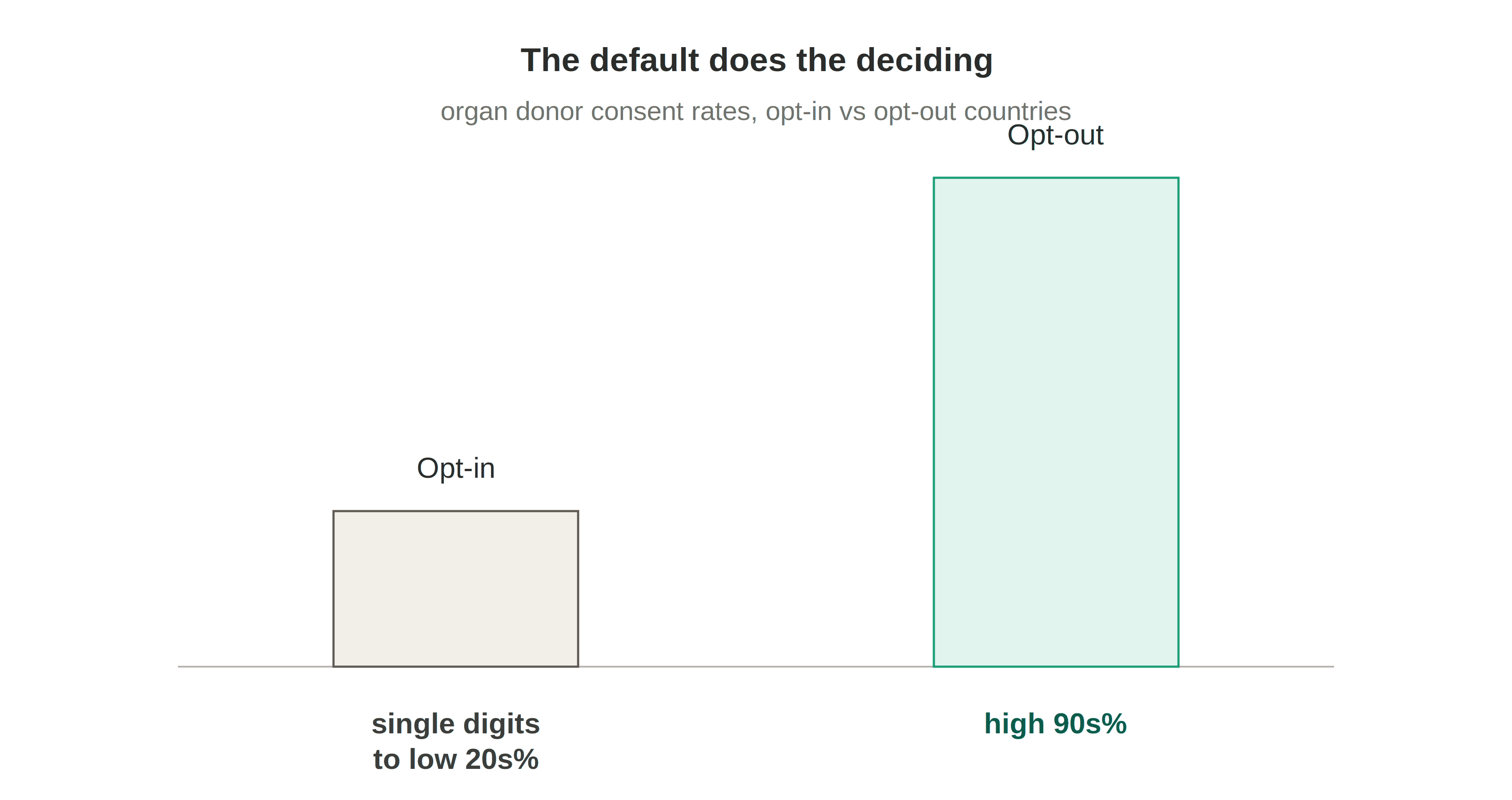
The paper compared organ donation consent rates across European countries otherwise similar in culture, wealth, and healthcare infrastructure, differing mainly in one administrative setting: whether citizens were registered as donors by default and had to actively opt out, or were not registered by default and had to actively opt in. Countries running opt-in systems saw effective consent cluster in the single digits to low twenties. Countries running opt-out systems saw consent rates run as high as the high 90s, a gap no survey of underlying personal attitudes toward organ donation could explain. Later controlled experiments by the same authors, randomly assigning opt-in, opt-out, and no-default conditions directly, found consent roughly twice as high under opt-out as under opt-in.
This is a genuinely new mechanism for this series, the default effect, closely related to status quo bias, without a dedicated formal model built out in the first three articles the way Salience Theory or Regret Theory got. Worth flagging plainly rather than force-fitting it into a citation that isn't really there.
It's also, unlike most of the case studies above, not a story where the theory aged perfectly: more recent research finds opt-out countries still facing real organ shortages, and some follow-up studies report weaker or mixed effects depending on how defaults are implemented alongside family veto rights and public awareness. The mechanism is real. It is not, on its own, sufficient, a fitting note to close this series' case-study tour on, since almost nothing covered across four articles has turned out to be sufficient on its own either.
Chapter 9Conclusion: What This Series Actually Argued
Go back to the beginning. A man loses a bonus that was never his. A retailer offers a print subscription nobody wants, and its only job is to make the bundle beside it look generous. A urinal gets a fly. A tax letter gets one sentence. A checkbox gets flipped from opt-in to opt-out, and somewhere, a family that would have said no to donating a stranger's organ never gets asked the question in a way that makes saying no the easy answer. None of these things changed a fact in the world. Every one of them changed a life, in some cases literally.
That's the part worth sitting with honestly, not just admiring. The same architecture that makes a hotel loyalty program quietly addictive, that makes a diamond feel like love instead of carbon, that makes a shrinking chocolate bar go unnoticed until it doesn't, is the architecture that also, when pointed at a different door, saves someone waiting for a kidney. There is no separate toolkit for exploitation and for good. There is one mind, reliably built the same way in a boardroom and a body about to die, and the only real variable across every case study in this series was who got there first and what they wanted from it.
Four articles ago, this series set out to explain why a man's bonus hurt like a loss he never actually had. It closes, now, on the uncomfortable symmetry of that same mechanism doing its best and its worst work with the identical hardware.
Not every case in this piece maps cleanly onto the nineteen formal models built along the way, and that gap deserves to stay visible rather than get smoothed over: signaling theory, psychophysics, plain nudge mechanics, these are real, adjacent fields this series never formally built out, sitting alongside the connections that do hold. Some of these twenty-two cases are near-literal restatements of a model this series spent an entire section deriving. Others are the same underlying instinct showing up somewhere the theory never expected to be tested.
One of them, the last one, isn't selling anything at all, and it may be the most honest thing in the whole series: proof that the deepest truth about human decision-making was never a marketing insight to begin with. It just got discovered by marketing first.
| Takeaway | Why It Matters |
|---|---|
| Salience Theory shows up far outside pricing, in physical space and brand design alike | The elevator mirrors, the Schiphol fly, Ogilvy's eye patch, and every anchored menu in this piece are the same attention-capturing mechanism from this series' first article, applied to a hallway, a photograph, or a wine list instead of a price comparison |
| Reference points get constructed by expectation, not handed down by a price tag | Rolls-Royce, IKEA, hotel status tiers, and J.C. Penney's crossed-out $40 price are four separate stagings of Kőszegi and Rabin's mechanism from this series' first article |
| Identity Economics turns up on a beer list and inside a diamond ring | Akerlof and Kranton's model, built for workplace and household behavior in this series' second article, explains why the cheapest drink and the smallest ring both carry a felt cost no price tag captures |
| Removing a moment of resistance works whether the goal is spending or saving | Acorns, Disney's MagicBand, and a menu with no dollar sign all engineer away the instant Gul and Pesendorfer's temptation model would price a resistance cost, pointed in opposite financial directions |
| More choices can mean noisier decisions, not just more tiring ones | Trader Joe's SKU limit is a direct lever on the same reasoning noise McKelvey and Palfrey's Quantal Response Equilibrium formalized in this series' second article |
| A government letter can do what a business pricing page does, using identical psychology | The UK's tax-compliance nudge and a hotel's scarcity banner both borrow the same social pressure this series' third article traced through informational cascades |
| The strongest case study in the entire series sells nothing | Organ donation defaults move life-and-death behavior with no product, no price, and no company profiting, proof this was never really about commerce to begin with |
Sources
Sutherland, R. (2019). Alchemy: The Dark Art and Curious Science of Creating Magic in Brands, Business, and Life. Penguin Random House; Norman, D. A. (1988). The Psychology of Everyday Things. Basic Books; Evans-Pritchard, B. (2013). "Aiming to Reduce Cleaning Costs." Works That Work; Norton, M. I., Mochon, D., & Ariely, D. (2012). "The IKEA Effect: When Labor Leads to Love." Journal of Consumer Psychology, 22(3), 453-460; Ogilvy, D. (1983). Ogilvy on Advertising. Crown Publishers; Sharp, B. (2010). How Brands Grow: What Marketers Need to Know. Oxford University Press; Ariely, D. (2008). Predictably Irrational: The Hidden Forces That Shape Our Decisions. HarperCollins; Thaler, R. H. (1985). "Mental Accounting and Consumer Choice." Marketing Science, 4(3), 199-214; Prelec, D., & Loewenstein, G. (1998). "The Red and the Black: Mental Accounting of Savings and Debt." Marketing Science, 17(1), 4-28; Nunes, J. C., & Drèze, X. (2006). "The Endowed Progress Effect: How Artificial Advancement Increases Effort." Journal of Consumer Research, 32(4), 504-512; Schwartz, B. (2004). The Paradox of Choice: Why More Is Less. Ecco; Cialdini, R. B. (2006). Influence: The Psychology of Persuasion. Harper Business; Kahneman, D. (2011). Thinking, Fast and Slow. Farrar, Straus and Giroux; Maister, D. H. (1985). "The Psychology of Waiting Lines." The Service Encounter, 113-123; Stewart, N. (2009). "The Cost of Anchoring on Credit-Card Minimum Repayments." Psychological Science, 20(1), 39-41; Johnson, E. J., & Goldstein, D. G. (2003). "Do Defaults Save Lives?" Science, 302(5649), 1338-1339; Hallsworth, M., List, J. A., Metcalfe, R. D., & Vlaev, I. (2017). "The Behavioralist as Tax Collector: Using Natural Field Experiments to Enhance Tax Compliance." Journal of Public Economics, 148, 14-31; Akerlof, G. A., & Kranton, R. E. (2000). "Economics and Identity." Quarterly Journal of Economics, 115(3), 715-753