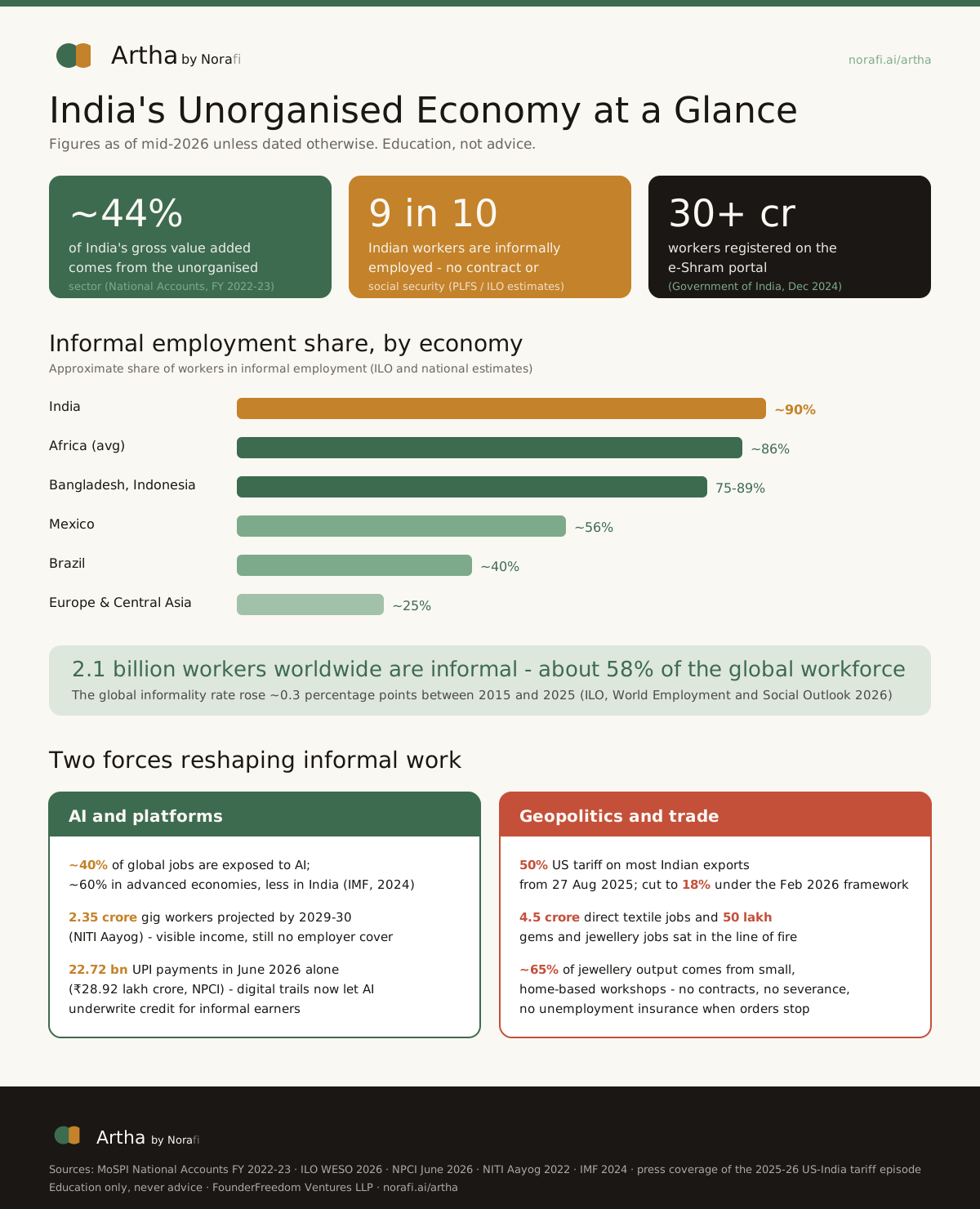
India's unorganised economy is not a side story to the "real" economy - in many ways it is the economy. The unorganised sector produced about 44-45% of India's gross value added in FY 2022-23 according to national accounts data, and roughly 9 in 10 Indian workers are informally employed, with no written contract, paid leave, or employer-funded social security. This one fact shapes almost everything else in Indian money life: why tax collections are narrow, why credit is hard for most households, why welfare is delivered the way it is, and why shocks like demonetisation, the pandemic, or the 2025 US tariffs hurt some Indians far more than others.
What counts as the unorganised economy?
The unorganised (or informal) economy covers economic activity that happens outside the net of formal registration, labour law, and social security - not illegal activity, just unregistered or unprotected activity. Two related but different ideas sit inside the term.
- Informal enterprises: unincorporated businesses that are not registered as companies - the kirana store, the roadside tailor, a three-person workshop, most farms.
- Informal employment: any job without social security or formal contract, even inside a formal company - a contract cleaner in a listed IT firm is formally employed by no one in practice.
The second definition is the bigger one. A large share of India's informal workers actually work in or around formal firms, through contractors and supply chains. That is why "formalising the economy" and "formalising jobs" are not the same project.
Chapter 2How big is India's unorganised economy?
As of the latest official estimates, the unorganised sector accounts for about 44% of India's gross value added (FY 2022-23, National Accounts Statistics), while informal employment covers close to 90% of all workers. The mismatch between those two numbers is the core of the story: the informal economy employs most Indians but produces less than half the output, which means informal productivity per worker is far below formal productivity.
Some specific, dated markers of scale:
- Nearly 98% of agricultural value added comes from the unorganised sector (FY 2022-23).
- The non-agricultural unorganised sector employs about 19% of the workforce but produces only around 6% of GDP, per MoSPI enterprise data released in 2024.
- Over 30 crore unorganised workers had registered on the government's e-Shram portal by December 2024 - the largest database of informal workers ever built, though registration alone does not guarantee benefits.
- NITI Aayog estimated India's gig workforce at 77 lakh in 2020-21, projected to reach 2.35 crore by 2029-30, or 6.7% of the non-agricultural workforce.
How does India compare with other countries?
India sits at the high end of a pattern visible across the developing world: the poorer the country, the larger the informal share. The ILO's World Employment and Social Outlook (2026) estimates that about 2.1 billion workers - nearly 58% of the global workforce - are informally employed, and that the global informality rate actually rose slightly (about 0.3 percentage points) between 2015 and 2025, driven partly by South Asia.
| Economy / region | Informal employment share | Notes |
|---|---|---|
| India | ~90% | PLFS-based estimates; among the world's largest informal workforces |
| Bangladesh, Indonesia | ~75-89% | ILO country groupings |
| Mexico | ~56% | Long-standing dual economy |
| Brazil | ~40% | Formalised significantly in the 2000s commodity boom |
| Africa (average) | ~86% | Highest regional rate (ILO) |
| Europe and Central Asia | ~25% | Lowest regional rate (ILO) |
The IMF estimates the informal sector produces about one third of economic activity in low and middle income countries, versus roughly 15% in advanced economies. No country has ever become rich with a 90% informal workforce; but equally, no country has formalised by decree. Brazil's partial success came from growth plus simplified micro-enterprise registration (its SIMPLES regime), not enforcement alone - a lesson India's GST composition scheme and Udyam registration consciously echo.
Chapter 4What role does the informal economy actually play?
The informal economy is simultaneously India's biggest safety net and its biggest productivity problem. Both things are true, and honest analysis holds them together.
The useful roles
- Employer of last resort. When formal hiring stalls, informal work absorbs people. After the 2020 lockdown, agriculture and informal services took back millions of workers who would otherwise have had zero income.
- Shock absorber. Informal firms have no compliance overhead and can restart with almost no capital. This flexibility is why Indian consumption recovers faster than formal payroll data suggests.
- Low-cost living infrastructure. Informal vendors, transport and services keep urban living costs down for everyone, including formal workers.
The costs
- A low-productivity trap. Informal firms stay tiny to stay invisible, so they cannot borrow, scale, or invest. Output per worker stays low, and so do wages.
- No protection. The ILO counts 284 million workers worldwide living in extreme poverty on under $3 a day; informal workers dominate that group. In India, an informal worker who falls ill typically has no sick pay and finances treatment out of pocket or through debt.
- A narrow tax base. When most economic activity is unregistered, the tax burden concentrates on the visible formal minority - one reason India's direct taxpayer base is small relative to its workforce.
- Credit invisibility. Without income proof, informal earners historically could not access formal credit, pushing them toward moneylenders at far higher rates.
Has India's formalisation push worked?
Partially - payments and identity have formalised much faster than jobs. Since 2016 India has run one of the world's largest formalisation experiments, and the results are uneven in an instructive way.
- Demonetisation (8 November 2016) was explicitly aimed at cash-heavy informal activity. Its measurable formalisation gains were limited, while the short-term shock fell hardest on informal workers themselves. (See the economics of demonetisation.)
- GST (1 July 2017) pulled lakhs of businesses into a registered chain because input tax credits only flow between registered firms - formalisation by incentive rather than force.
- UPI processed 22.72 billion transactions worth about ₹28.92 lakh crore in June 2026 alone (NPCI data) - roughly 757 million payments a day. A street vendor with a QR code now generates a digital income trail that did not exist a decade ago.
- e-Shram (2021 onward) gave informal workers a portable national identity as workers, crossing 30 crore registrations by late 2024.
A widely cited SBI Research estimate claimed the informal share of GDP fell from about 52% in FY 2017-18 to around 20% by FY 2020-21. That figure is contested - it partly captured pandemic-year distortion, when informal activity collapsed rather than formalised - and official statisticians were still refining informal-sector measurement in consultations as recently as January 2025. The honest reading, as of July 2026: transactions and identities have formalised dramatically; job quality and social security have moved much more slowly. Researchers call this "narrow formalisation" - workers become visible to the state without gaining the protections that define formal work.
Chapter 6What is AI doing to informal work?
AI is pulling the informal economy in two directions at once: it is formalising informal workers through platforms and data, while creating a new kind of algorithm-managed precarity. The IMF's 2024 analysis estimated that almost 40% of global employment is exposed to AI - around 60% in advanced economies but considerably less in India, because most Indian workers are in farm, craft and elementary occupations that AI does not directly touch.
Three effects matter for India specifically:
- Platformisation. Ride-hailing, delivery and home-services apps convert informal work into recorded, rated, digitally paid work. That is real formalisation of income trails - but the worker is typically still a "partner" without employer-funded social security, now managed by an algorithm that sets pay and hours. India's gig workforce, headed toward NITI Aayog's projected 2.35 crore by 2029-30, lives exactly in this in-between zone.
- AI-enabled credit. Lenders now underwrite informal earners using UPI flows, GST data and account aggregator records instead of salary slips. For a vendor or driver, an AI-read transaction history is becoming the substitute for the income proof they never had.
- Indirect exposure. The larger AI risk to informal India is second-hand: if AI compresses formal-sector jobs in IT, BPO and back-office services, displaced formal workers compete downward, and the informal economy is where that pressure lands.
How do geopolitical tensions hit informal workers?
Geopolitics reaches the informal economy through export supply chains, and the 2025-26 US tariff episode is the clearest recent example. From 27 August 2025, the US imposed tariffs of 50% on most Indian exports, hitting exactly the sectors where informal work concentrates: textiles and garments (about 4.5 crore direct workers), gems and jewellery (about 50 lakh direct workers, with roughly 65% of production coming from small, home-based workshops), leather and footwear. Exporters in these sectors reported turnover declines of up to 50%, and analysts at the time projected Indian exports to the US could fall from about $86.5 billion toward $50 billion if the full tariffs persisted.
The episode also showed how quickly the weather can change. Under a framework announced in February 2026, the US agreed to cut the reciprocal tariff on India from 25% to 18% and to remove the additional 25% penalty tied to Russian oil purchases; as of early July 2026, negotiators on both sides described a final deal as nearly closed. For the diamond polisher in Surat or the garment worker in Tiruppur, none of this was ever abstract - order books, daily wages and job continuity moved with each announcement.
The same channel runs through other tensions - Red Sea shipping disruptions raising freight costs for small exporters, and the "China plus one" shift, which cuts the other way: electronics assembly moving to India has created lakhs of new factory jobs, many of them a step up from informal work even when contractual.
Chapter 8What this means for you
Understanding the unorganised economy is understanding the base layer of Indian money life. If you are a salaried, EPF-covered reader, you are in roughly the top tenth of Indian workers by job protection, and the prices you pay every day are subsidised by informal labour. If you or your family earn informally, the trends above describe your world: digital trails via UPI and platforms are slowly opening formal credit and welfare access, while global shocks and algorithmic management add new kinds of risk. Either way, the direction of travel as of mid-2026 is clear - India is formalising payments and identity first, and jobs last - and knowing that helps you read every budget announcement, employment headline and welfare scheme for what it actually changes. (For the classic theory of why informality persists, see Hernando de Soto's argument.)
How Nora helps
Nora helps you make sense of how big-picture economics reaches your own money - from what a tariff headline means for jobs in your city to how a digital payment trail changes what a lender can see about you. Ask Nora to break down any economic development in plain language, and to show what it does and does not change for your household.
App · coming soon